In the rapidly accelerating world of artificial intelligence, 2026 stands out as a pivotal year for global innovation. As we look toward the horizon of next-generation large language models (LLMs), the question on every tech enthusiast’s lips is how the landscape will shift during the chatgpt 5 vs claude 4 2026 showdown. This isn’t just a battle of benchmarks; it is a fundamental shift in how humans interact with digital intelligence, moving from simple chatbots to autonomous agents capable of complex reasoning and multi-step execution. In this comprehensive guide, we will analyze the predicted features, performance metrics, and societal impacts of these two titans of the AI industry.
Table of Contents
- The AI Evolution: Why 2026 is the Critical Milestone
- ChatGPT 5: Moving Toward Artificial General Intelligence (AGI)
- Claude 4: The Pinnacle of Safety and Contextual Intelligence
- Head-to-Head Comparison: ChatGPT 5 vs Claude 4 2026
- The Business Landscape in 2026: Implementation Strategies
- Projected Technical Benchmarks and Reasoning Capabilities
- Actionable Advice: How to Prepare Your Workflow Today
- Conclusion: The Winner of the 2026 AI Supremacy
The AI Evolution: Why 2026 is the Critical Milestone
By the time we reach 2026, the generative AI craze will have transitioned into a phase of deep integration. We are no longer just asking AI to write emails; we are asking it to manage entire projects. The chatgpt 5 vs claude 4 2026 competition represents the peak of this transition. Historically, OpenAI has led with raw power and first-mover advantage, while Anthropic has carved out a niche through precision, safety, and a superior “human-like” writing style.
Experts suggest that 2026 will be the year where “Agentic AI” becomes the standard. This means both ChatGPT 5 and Claude 4 will not just generate text, but will possess the agency to browse the web, use software tools, and interact with other AI agents to complete complex goals. The infrastructure of 2026 will support massive compute clusters, allowing these models to process information at a scale previously unimaginable.
“The difference between the models of 2024 and 2026 is akin to the difference between a high-end calculator and a full-time digital employee.” — Industry Analyst Projection
ChatGPT 5: Moving Toward Artificial General Intelligence (AGI)
OpenAI’s roadmap suggests that ChatGPT 5 (often referred to by internal project code names like ‘Orion’ or ‘Strawberry-evolved’) will focus on deeper reasoning. Unlike previous iterations that occasionally hallucinated or struggled with multi-step logic, ChatGPT 5 is expected to incorporate a system of self-correction. In the context of chatgpt 5 vs claude 4 2026, ChatGPT 5 is likely to dominate in the following areas:
- Advanced Multimodality: Seamlessly processing and generating video, audio, code, and 3D environments in real-time.
- Autonomous Execution: The ability to use a computer like a human, navigating apps to book travel, update CRM systems, or manage software deployments.
- Personalization: A “long-term memory” that allows the model to understand the user’s preferences, past projects, and specific communication style across months of interaction.
The goal for ChatGPT 5 is to reduce the need for precise prompting. It should “know what you mean” even if your instructions are vague, using its enhanced reasoning capabilities to fill in the gaps. This leap toward AGI (Artificial General Intelligence) is what many believe will keep OpenAI at the top of the leaderboard in the chatgpt 5 vs claude 4 2026 race.
Claude 4: The Pinnacle of Safety and Contextual Intelligence
Anthropic has always prioritized “Constitutional AI,” ensuring that their models are helpful, honest, and harmless. Claude 4 is expected to be the most sophisticated implementation of this philosophy. When comparing chatgpt 5 vs claude 4 2026, Claude 4 will likely excel in sectors that require high levels of trust and nuance, such as legal, medical, and scientific research.
Key Features of Claude 4
Claude 4 is rumored to push the boundaries of what a “context window” can handle. We might see windows of up to 5 or 10 million tokens, allowing the model to analyze entire libraries of corporate documentation in a single prompt. This makes Claude 4 an invaluable tool for enterprises that deal with massive data silos.
- Human-Centric Reliability: Further reducing hallucination rates to near-zero for factual queries.
- Nuanced Creative Writing: Maintaining the “warmth” and stylistic fluidity that has made Claude 3.5 a favorite among writers.
- Privacy-First Architecture: Enhanced localized processing for enterprise clients who cannot risk their data leaving private clouds.
Head-to-Head Comparison: ChatGPT 5 vs Claude 4 2026
To better understand the chatgpt 5 vs claude 4 2026 landscape, we have compiled a comparison of their projected capabilities based on current development trajectories and industry leaks.
| Feature | ChatGPT 5 (Projected) | Claude 4 (Projected) |
|---|---|---|
| Primary Strength | Autonomous Task Execution & Agency | Reasoning, Safety, & Context Window |
| Context Window | 2M – 4M Tokens | 5M – 10M Tokens |
| Multimodality | Full (Text, Voice, Video, Action) | High (Focus on Document/Image Analysis) |
| Reasoning Engine | In-built “System 2” thinking/verification | Recursive self-improvement & logic checks |
The Business Landscape in 2026: Implementation Strategies
As businesses decide between chatgpt 5 vs claude 4 2026, the choice will depend on the specific organizational needs. Companies looking for a “digital assistant” that can actively operate software should look toward OpenAI. Meanwhile, companies requiring rigorous data analysis and safe, predictable outputs for client-facing work may lean toward Anthropic.
In 2026, we will see the rise of “AI Orchestration,” where developers use both models for different parts of a workflow. For example, Claude 4 might be used to analyze a 2,000-page legal contract (utilizing its massive context window), while ChatGPT 5 is tasked with using that analysis to autonomously draft and send emails to opposing counsel and adjust entries in a billing system.
Projected Technical Benchmarks and Reasoning Capabilities
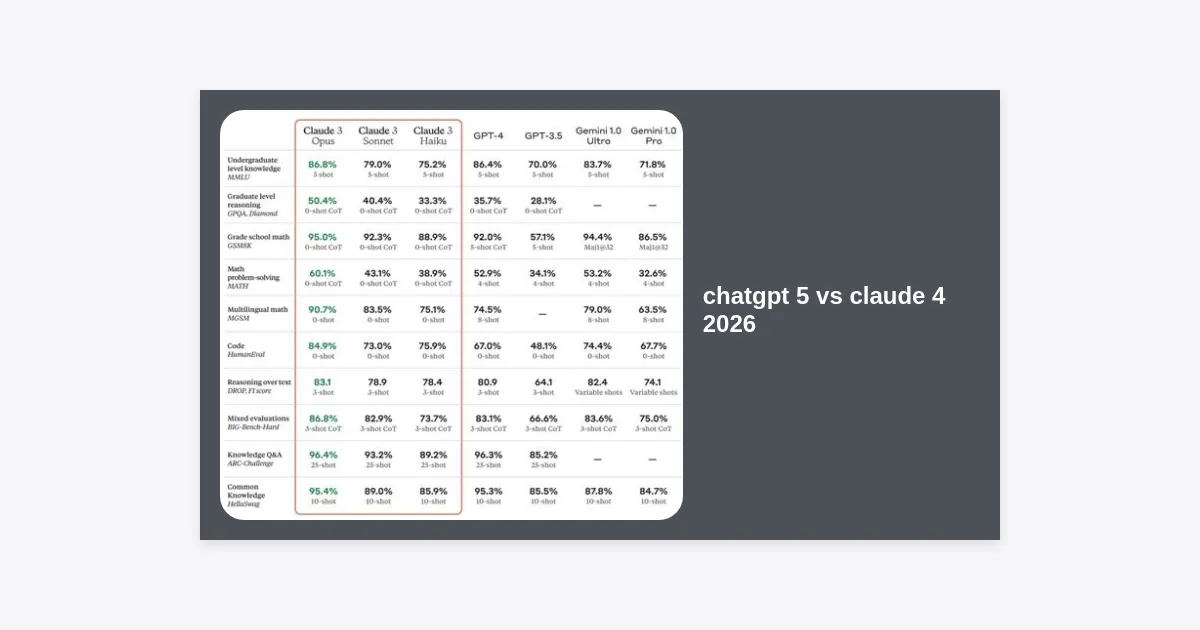
Benchmarks like MMLU (Massive Multitask Language Understanding) and GPQA (Graduate-Level Google-Proof Q&A) will likely see scores exceeding 95% by 2026. In the chatgpt 5 vs claude 4 2026 comparison, we expect OpenAI to lead in mathematical and coding benchmarks (HumanEval), while Anthropic may hold the edge in linguistic nuance and qualitative reasoning.
One of the metrics that will gain prominence in 2026 is “Time-to-Solution” for complex tasks. This measures how long it takes an AI to complete an multi-step agentic task (e.g., “Research this competitor, build a marketing strategy, and draft the first five ads”). We anticipate both models will reduce the human-equivalent time for such tasks by over 90%.
Actionable Advice: How to Prepare Your Workflow Today
Waiting until 2026 to adopt these technologies will put you behind the curve. To make the most of the chatgpt 5 vs claude 4 2026 era, you should start taking these practical steps today:
- Formalize Your Data Structure: Next-gen models thrive on clean data. Ensure your business records are digitized and organized so they can be easily ingested by large context models like Claude 4.
- Master Agentic Prompting: Stop thinking about AI as a search engine. Start thinking about it as a manager. Practice giving instructions that define a goal, rather than just a single output.
- Evaluate Privacy Risks: In the 2026 landscape, data is the currency of AI. Research how both OpenAI and Anthropic handle enterprise data to ensure your intellectual property remains secure.
- Upskill Your Team: Focus on “AI Literacy”—understanding which model (ChatGPT 5 or Claude 4) is better suited for a specific task.
For those looking for a deeper breakdown of these strategies, you can download our comprehensive AI Readiness Checklist below.
Conclusion: The Winner of the 2026 AI Supremacy
Deciding a definitive winner in the chatgpt 5 vs claude 4 2026 battle is difficult because their paths are diverging. OpenAI is building an actor—a model that can do things for you. Anthropic is building a thinker—a model that can understand and process everything for you with unmatched reliability.
The real winners will be the users and businesses that learn to leverage both models effectively. By 2026, AI will no longer be a novelty; it will be the operating system for modern business and creative life. Stay informed, stay adaptable, and prepare for a future where the line between human effort and machine intelligence becomes beautifully blurred.
Key Takeaways:
- ChatGPT 5 will likely lead in agentic capabilities and autonomous software interaction.
- Claude 4 will likely excel in context window size and safety-critical reasoning.
- Multimodality will be the standard for both models by 2026.
- Preparation begins with data organization and AI literacy today.