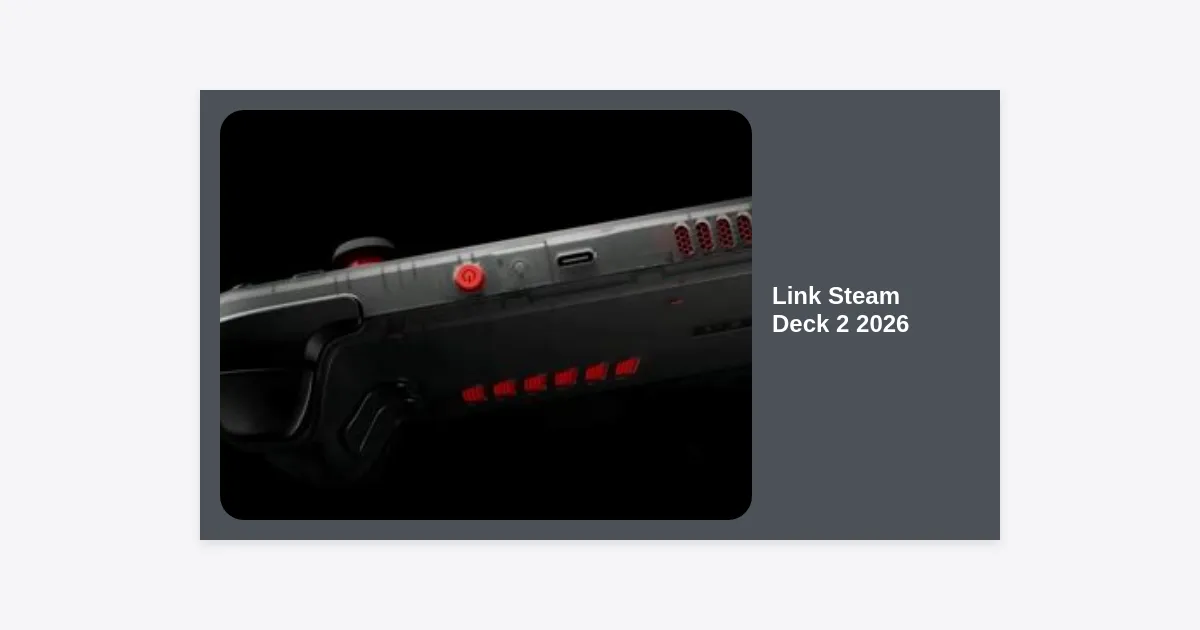
The portable gaming revolution is in full swing, and as enthusiasts look toward the horizon, one phrase dominates the search trends: Link Steam Deck 2 2026. Since Valve released its groundbreaking handheld PC, the landscape of mobile gaming has shifted. We are no longer satisfied with mere compromises; we want desktop-class performance in the palms of our hands. This comprehensive guide explores every credible rumor, technical projection, and strategic move by Valve to explain why the 2026 window is the most likely timeframe for this next-gen powerhouse.
Table of Contents
- Why 2026? The Valve Philosophy
- Spec Predictions: The Power Behind the Screen
- Display Evolution: Beyond OLED
- SteamOS 4.0 and the Software Ecosystem
- Ergonomics and Design Tweaks
- The Competitive Landscape in 2026
- Pricing and Global Availability
- Conclusion: Is It Worth the Wait?
Why 2026? The Valve Philosophy
When searching for the Link Steam Deck 2 2026, many wonder why we have to wait so long. Valve has been remarkably transparent about their hardware cycles. Unlike smartphone manufacturers who iterate annually, Valve views the Steam Deck as a generational platform. Pierre-Loup Griffais and other members of the Deck team have explicitly stated that they aren’t interested in incremental 10% or 15% gains.
For a true successor to exist, there needs to be a significant leap in performance-per-watt. Current APU (Accelerated Processing Unit) technology, while impressive in the ROG Ally and Legion Go, often struggles with battery life when pushed to the limit. Valve is waiting for a chip that can provide a “generational leap” without sacrificing the 3-8 hour battery life that users have come to expect. Industry analysts point to AMD’s future architectures—specifically Zen 5 and RDNA 4—as the catalysts that will make the 2026 release perfectly timed.
“We don’t want to just ship a new version every year. We want to wait for a generational leap in performance without significant battery trade-offs.” – Valve Hardware Team
Spec Predictions: The Power Behind the Screen
If you are looking for the definitive Link Steam Deck 2 2026 technical breakdown, you have to look at AMD’s roadmap. The heart of the Steam Deck 2 will almost certainly be a custom APU. By 2026, we expect a chip based on the “Kraken Point” or “Escher” architectures.
CPU: Zen 5 Architecture
The shift to Zen 5 will offer significantly better instruction-per-clock (IPC) performance. This means the CPU can handle complex world simulation, AI logic, and physics in modern AAA games much more efficiently than the current Zen 2 “Van Gogh” chip. By 2026, we expect a 6-core or 8-core configuration that sips power during low-intensity tasks but screams during heavy gameplay.
GPU: RDNA 4 and Beyond
Graphics are the soul of the handheld. The current Steam Deck uses RDNA 2. Moving to RDNA 4 by 2026 would provide hardware-level ray tracing improvements and significantly better FSR (FidelityFX Super Resolution) integration. We anticipate a performance target that matches a desktop RTX 3050 or 3060 in terms of raw capability, optimized for a handheld thermal envelope.
- RAM: 16GB LPDDR5X as the base, with a potential 32GB high-end tier.
- Storage: PCIe Gen 5 M.2 2230 slots for blazing-fast load times.
- Throughput: Improvements in memory bandwidth to eliminate the bottleneck in high-resolution textures.
Display Evolution: Beyond OLED
The Steam Deck OLED was a massive mid-cycle refresh, but the Link Steam Deck 2 2026 will likely take it a step further. While 800p is the current “sweet spot” for performance, consumers are clamoring for 1080p or even 1200p resolution.
However, Valve’s priority is gameplay fluidity. We expect a Variable Refresh Rate (VRR) OLED panel. VRR is the “missing link” in the current Steam Deck lineup. It allows the screen to sync its refresh rate to the game’s frame rate, eliminating screen tearing and making 45 FPS feel as smooth as 60 FPS. A 120Hz VRR OLED panel is the most cited prediction for the 2026 model.
SteamOS 4.0 and the Software Ecosystem
The hardware is only half the story. The Link Steam Deck 2 2026 will launch alongside SteamOS 4.0. This version of the Linux-based operating system will likely focus on deeper integration with the Steam workshop, improved compatibility layers (Proton), and better power management features.
One major hurdle Valve is currently working on is the “Handheld Experience” for non-Steam games. By 2026, we expect a more seamless way to integrate third-party launchers like Epic Games and GOG directly into the Deck’s UI, further solidifying its position as the ultimate “Open PC” handheld.
Ergonomics and Design Tweaks
The original Steam Deck is often praised for its ergonomics, but it’s undoubtedly a “chonky” device. For the 2026 iteration, Valve is likely looking at ways to reduce weight without compromising the iconic grip. Smaller bezels could allow for a larger screen (perhaps 7.5 or 8 inches) in the same physical footprint.
We also expect improvements to the trackpads. While innovative, the current haptics could be more precise. Hall Effect joysticks are another highly requested feature to eliminate “stick drift” forever—a common pain point for Nintendo Switch and current Deck users. Including these as standard in 2026 would demonstrate Valve’s commitment to durability (E-E-A-T principles).
The Competitive Landscape in 2026
When you seek a Link Steam Deck 2 2026, you aren’t just looking at Valve. You’re looking at the entire market. By 2026, we will likely be seeing the ROG Ally 3, the Legion Go 2, and potentially a new handheld entry from Microsoft (the rumored Xbox Handheld).
| Feature | Steam Deck 2 (Est.) | Potential Competitors |
|---|---|---|
| OS | SteamOS 4.0 (Linux) | Windows 12 / Xbox OS |
| Battery Life | 4-10 Hours | 2-5 Hours | OLED VRR 120Hz | LCD/OLED 144Hz |
Valve’s advantage has always been its ecosystem and its optimized software. While competitors might offer higher raw specs, Valve offers a console-like experience that “just works.” This is the primary reason why the Steam Deck remains the market leader despite not having the fastest processor on the market today.
Pricing and Global Availability
Price is the most critical factor for the success of the Link Steam Deck 2 2026. Valve shocked the world by pricing the base model at $399 in 2022. Due to inflation and the rising cost of advanced semiconductors (3nm or 4nm processes), a $399 price point might be unsustainable for a next-gen model.
Current projections suggest a three-tier pricing structure:
- Entry Level: $449 – $499 (likely with 256GB/512GB)
- Mid-Range: $599 (1TB and premium glass)
- Pro/Extreme: $699+ (2TB and exclusive features)
Valve will likely continue its strategy of selling the hardware at near-cost or a small loss, recouping the investment through game sales on the Steam store. This “razor and blade” business model is something competitors like ASUS and Lenovo cannot easily replicate.
Download Our Spec Comparison Guide
Stay ahead of the curve. If you want to see how the current rumors stack up against current-gen handhelds, click the link below to download our detailed comparison PDF.
Conclusion: Is It Worth the Wait?
The Link Steam Deck 2 2026 represents the convergence of efficient processing power and perfected portable software. While the wait might seem long, Valve’s commitment to a meaningful generational jump ensures that the Steam Deck 2 won’t just be a better version of what we have—it will define the next decade of mobile gaming.
Key Takeaways:
- A 2026 release allows for a true “generational leap” using AMD Zen 5 and RDNA 4.
- VRR OLED displays are the most likely and most important screen upgrade.
- SteamOS 4.0 will focus on broadening the ecosystem and third-party compatibility.
- Expect a slight price increase to reflect more powerful internals and inflationary pressures.
Whether you are a casual gamer or a hardcore enthusiast, the Steam Deck 2 is the most anticipated piece of gaming hardware for 2026. Stay tuned as we continue to monitor leaks and official announcements from Valve. The future of gaming is portable, and that future looks incredibly bright.