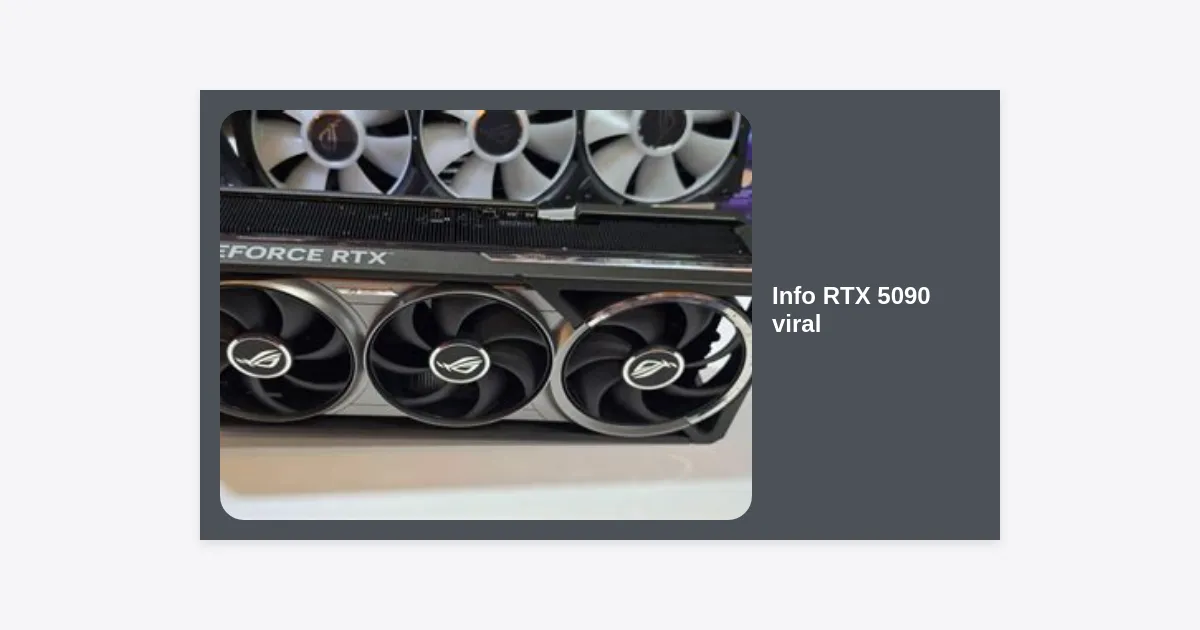
The hardware world is currently in a state of high-octane anticipation as the latest Info RTX 5090 viral leaks suggest a performance leap unlike anything we have seen in the last decade. Every few years, a product comes along that doesn’t just iterate on the previous generation but completely redefines the boundaries of consumer technology. For PC enthusiasts, gamers, and AI professionals, the GeForce RTX 5090 is that product. Whether you are looking for frame rates that saturate a 4K 240Hz monitor or the raw TFLOPS required for local LLM training, the buzz surrounding this card is undeniable.
- Why the Info RTX 5090 Viral News is Dominating Tech Circles
- The Blackwell Architecture: Going Beyond Ada Lovelace
- Hardware Specifications: Breaking Down the Rumors
- Performance Projections: 5090 vs 4090
- Power Consumption and Thermal Management
- The Intersection of Ultra-Gaming and Artificial Intelligence
- Release Date and Pricing: What to Expect
- Actionable Advice: Preparing for the Upgrade
- Conclusion and Final Thoughts
Why the Info RTX 5090 Viral News is Dominating Tech Circles
It is no secret that NVIDIA currently holds the crown in the high-end GPU market. However, the reason the recent Info RTX 5090 viral reports have gained such traction is the sheer scale of the rumored improvements. Unlike the transition from the 30-series to the 40-series, which focused heavily on efficiency and DLSS 3, the Blackwell-based 5090 is touted as a raw power monster.
Social media platforms like X (formerly Twitter), Reddit, and specialized tech forums have been flooded with leaked block diagrams and manufacturing manifests. These leaks suggest that NVIDIA is leaning into the “Blackwell” architecture, which was initially designed for data centers, to bring unprecedented compute capabilities to the home desktop. This convergence of professional-grade power and consumer accessibility is why the Info RTX 5090 viral trend continues to grow daily.
For the average consumer, this means that features which were once considered “next-gen,” such as path tracing at native 4K or real-time AI video upscaling, are becoming the standard. The excitement isn’t just about faster games; it’s about a fundamental shift in how we interact with digital media.
The Blackwell Architecture: Going Beyond Ada Lovelace
At the heart of the Info RTX 5090 viral frenzy is the GB202 GPU core. Based on the Blackwell architecture, this chip is expected to be manufactured using a refined version of TSMC’s 4N (5nm class) process, or potentially a jump to the 3nm node depending on yield stability. The architecture is specifically optimized for high-density compute tasks.
One of the primary innovations expected in Blackwell is the overhaul of the Streaming Multiprocessor (SM) structure. Rumors suggest that NVIDIA has found a way to significantly increase the throughput of Ray Tracing (RT) cores and Tensor cores, moving toward a world where ray tracing is no longer a “performance hit” but a native part of the rendering pipeline.
“The Blackwell architecture isn’t just a step forward; it’s a leap into a multi-chip module (MCM) future, even if the 5090 remains monolithic for now,”
says leading industry analysts.
Hardware Specifications: Breaking Down the Rumors
When searching for Info RTX 5090 viral specs, certain numbers keep appearing across various credible leakers like Kopite7kimi. While nothing is official until Jensen Huang takes the stage, the consensus is building around a set of monstrous specifications:
- CUDA Cores: Estimates range from 18,432 to over 24,000 cores. This would represent a 30-50% increase over the RTX 4090.
- Memory Type: The 5090 is almost certain to debut the new GDDR7 memory standard, offering much higher bandwidth and improved power efficiency per gigabit.
- VRAM Capacity: Expect at least 24GB, with strong rumors pointing toward a 32GB variant to satisfy AI researchers and 8K video editors.
- Memory Bus: A potential 512-bit bus width is being discussed, which would provide over 1.5 TB/s of bandwidth.
- Interface: Full support for PCIe 5.0, doubling the theoretical bandwidth between the GPU and the CPU compared to PCIe 4.0.
Performance Projections: 5090 vs 4090
The core of why people are searching for Info RTX 5090 viral updates is the performance delta. Early synthetic benchmark leaks suggest that the RTX 5090 could be 1.6x to 1.8x faster than the RTX 4090 in heavy rasterization workloads. In ray-traced scenarios, the gap might widen even further due to the dedicated hardware improvements in the Blackwell RT cores.
To put this into perspective, consider the following data points based on projected performance averages compared to current flagships:
| Metric | RTX 4090 (Actual) | RTX 5090 (Projected) |
|---|---|---|
| 4K Gaming Performance | 100% (Baseline) | 160% – 180% |
| Memory Bandwidth | 1,008 GB/s | ~1,536 GB/s |
| Ray Tracing Efficiency | Generation 3 | Generation 4+ |
| AI Compute (TFLOPS) | ~1.3 Petaflops | ~2.1+ Petaflops |
Power Consumption and Thermal Management
One aspect of the Info RTX 5090 viral news that has caused some concern is the power draw. Reports indicate a Total Graphics Power (TGP) of up to 600W for the flagship model. This creates a massive challenge for thermal management. We expect to see more 3.5-slot and even 4-slot cooler designs, with liquid cooling becoming more of a standard requirement rather than an enthusiast luxury.
NVIDIA is also rumored to be refining the 12V-2×6 power connector to prevent the melting issues that plagued some early 4090 units. Strong recommendation: If you are planning to buy a 5090, do not skimp on your Power Supply Unit (PSU). An ATX 3.1 compliant PSU with at least 1000W-1200W capacity will likely be the safety baseline.
The Intersection of Ultra-Gaming and Artificial Intelligence
The Info RTX 5090 viral discussion isn’t just for gamers. The boom in generative AI has made high-VRAM consumer GPUs more valuable than ever. The RTX 5090 is positioned to be the ultimate local AI workstation card. With 32GB of GDDR7 memory, users will be able to run significantly larger Large Language Models (LLMs) and training batches that were previously restricted to expensive enterprise-grade A100 or H100 cards.
On the gaming front, we expect the introduction of DLSS 4. While details are slim, Info RTX 5090 viral leaks suggest DLSS 4 will move beyond frame generation into “AI-generated textures” or “AI-driven physics,” offloading even more of the traditional rendering pipeline to the Tensor cores. This would allow for photorealistic environments at ultra-high refresh rates.
Release Date and Pricing: What to Expect
Historically, NVIDIA releases its flagship cards in the final quarter of the year. Most Info RTX 5090 viral sources point toward a Q4 2024 or Q1 2025 announcement. Pricing is where things get tricky. Given the lack of competition from AMD in the ultra-enthusiast tier (as AMD is rumored to be focusing on mid-range for the next generation), NVIDIA has little pressure to keep prices low.
Expect a launch price between $1,699 and $1,999 USD. While this is a significant investment, the value proposition lies in the fact that this card will likely remain the performance leader for at least 3-4 years, much like the 1080 Ti did in its heyday.
Actionable Advice: Preparing for the Upgrade
If you are serious about following the Info RTX 5090 viral hype and purchasing one on launch day, here is what you should do right now:
- Evaluate your Case: Check the clearance. Most 5090 cards will exceed 340mm in length. Make sure your chassis can breathe.
- Upgrade your PSU: Don’t wait for the rush. Look for a high-quality ATX 3.1 power supply now.
- Monitor Check: A 1440p monitor is a bottleneck for this card. Consider moving to 4K 144Hz+ or even a 5K/8K panel to actually utilize the horsepower.
- Save early: Given the potential $2,000 price tag, starting a dedicated “GPU fund” now will make the launch-day purchase much easier.
For a detailed breakdown of compatible hardware and a checklist for your build, you can refer to our community-sourced hardware guide.
Conclusion and Final Thoughts
The Info RTX 5090 viral news highlights a pivotal moment in hardware history. We are seeing the lines between consumer gaming and professional AI workstations blur into one singular, powerful device. While the power requirements and price tags are reaching new heights, so is the potential for immersive digital experiences.
Key Takeaways:
- The RTX 5090 will use the Blackwell architecture (GB202).
- Expected performance gains are 60-80% over the RTX 4090.
- GDDR7 and a 512-bit bus will revolutionize memory bandwidth.
- AI workloads will benefit immensely from increased VRAM and new Tensor cores.
Stay tuned to authoritative tech outlets and NVIDIA’s official channels as we approach the end of the year. The 50-series era is almost upon us, and it promises to be nothing short of spectacular.