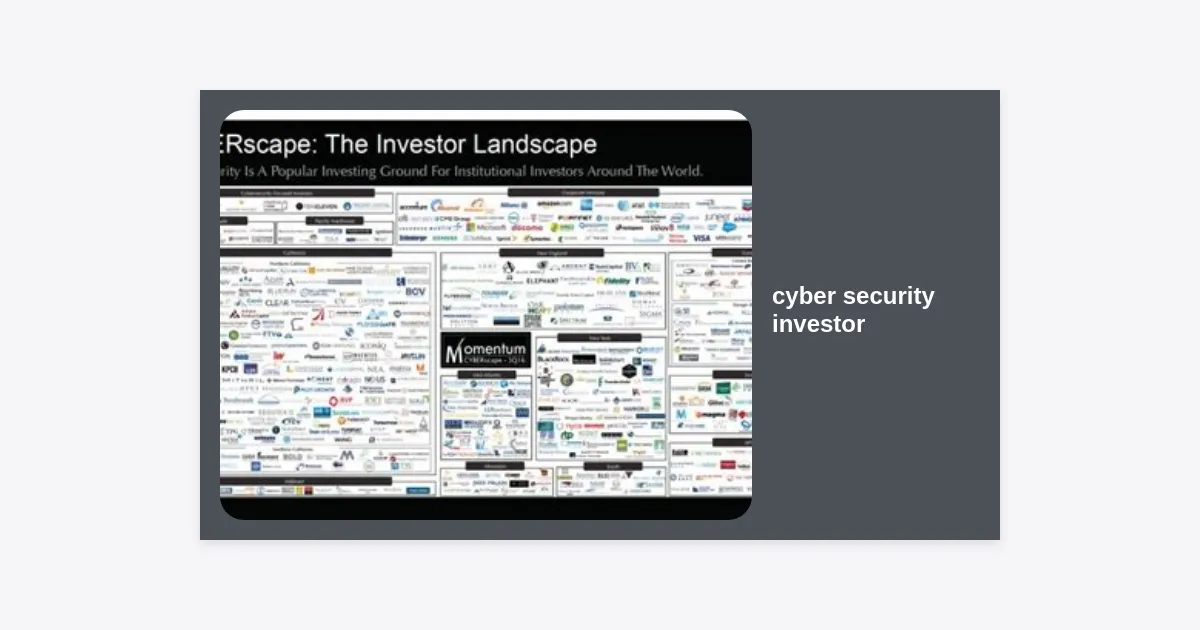
In an era where a single data breach can wipe out billions in market capitalization overnight, the role of a cyber security investor has never been more critical—or more lucrative. As digital transformation accelerates, the perimeter of the modern enterprise has dissolved, leaving behind a fragmented landscape that requires constant protection. For the forward-thinking cyber security investor, this represents a unique opportunity to capitalize on a sector that is increasingly viewed as a non-discretionary utility rather than a luxury IT expense.
Table of Contents
- The Market Dynamics: Why Invest in Cyber Security Now?
- Types of Cyber Security Investments
- The Cyber Security Investor’s Due Diligence Checklist
- Top 5 High-Growth Sectors to Watch
- Managing Risks and Navigating Market Volatility
- How to Build Your Cyber Security Portfolio
- Conclusion: The Long-Term Outlook
The Market Dynamics: Why Invest in Cyber Security Now?
To understand the mindset of a successful cyber security investor, one must first recognize the sheer scale of the threat landscape. Cybercrime is projected to cost the global economy upwards of $10.5 trillion annually by 2025. This staggering figure has transformed security from a back-office concern into a boardroom priority.
Unlike many other technology sectors, cyber security is notably recession-resistant. Companies may cut back on marketing or experimental R&D during economic downturns, but they cannot afford to stop defending their data. A security breach during a recession can be terminal for a mid-market enterprise, forcing sustained spending regardless of the macroeconomic climate.
Furthermore, the regulatory environment is tightening globally. Laws like GDPR in Europe, CCPA in California, and various federal mandates have created a “compliance floor.” This floor ensures that a cyber security investor is backing products that companies are effectively mandated to buy by law.
“Cyber security is no longer an IT problem; it is a fundamental business risk that requires a strategic investment approach to mitigate effectively.”
Types of Cyber Security Investments
Every cyber security investor must decide where they sit on the risk-reward spectrum. The market offers several distinct entry points, each with its own set of characteristics and liquidity profiles.
1. Venture Capital and Early-Stage Startups
This is where the most significant multipliers are found. Investing in a pre-seed or Series A security firm requires a deep understanding of emerging technical trends. Here, you are betting on the team’s ability to solve a problem that might not even be fully realized by the market yet, such as quantum-resistant encryption.
2. Publicly Traded Cybersecurity Stocks
For the cyber security investor seeking liquidity, names like CrowdStrike, Palo Alto Networks, and Zscaler provide exposure to established market leaders. These companies have proven business models, recurring revenue via SaaS, and a platform approach that allows them to upsell existing clients easily.
3. Exchange-Traded Funds (ETFs)
If you prefer a diversified approach, ETFs like HACK or CIBR offer a basket of security companies. This mitigates the risk of a single company failing due to a high-profile hack on their own infrastructure—a unique risk that every cyber security investor must consider.
The Cyber Security Investor’s Due Diligence Checklist
Due diligence in this niche is notoriously difficult because the underlying technology is highly complex. A cyber security investor must look beyond the marketing jargon of “AI-powered” and “Next-Gen” to find true value.
- Technical Efficacy: Does the product actually work in a live environment, or is it “shelfware”? Third-party labs like SE Labs or MITRE Engenuity provide invaluable benchmarking data.
- Total Addressable Market (TAM): Is the solution solving a niche problem or a systemic one? A tool that only secures one specific type of legacy database has a much lower ceiling than a universal Cloud Native Application Protection Platform (CNAPP).
- Customer Retention: Look for Net Revenue Retention (NRR). In cyber security, if a customer isn’t expanding their usage, they are likely looking for a replacement.
- Team Expertise: Does the founding team have background in intelligence agencies (like the NSA or Unit 8200) or high-level corporate security? Pedigree matters in this industry.
Top 5 High-Growth Sectors to Watch
The savvy cyber security investor stays ahead of the curve by identifying which sub-sectors are moving from the “early adopter” phase to “mainstream necessity.” Currently, five areas stand out:
1. Identity and Access Management (IAM)
In a world of remote work, identity is the new perimeter. Companies are moving away from passwords toward biometric and multi-factor authentication (MFA). Zero Trust architectures rely heavily on knowing exactly who is accessing what at all times.
2. Cloud Security Posture Management (CSPM)
As enterprises migrate to AWS, Azure, and Google Cloud, misconfigurations become the leading cause of data leaks. Tools that automatically find and fix these errors are seeing massive adoption rates.
3. AI and Machine Learning Security
This is a double-edged sword. Hackers are using AI to create more convincing phishing campaigns and automated malware. Consequently, a cyber security investor should look for firms using AI to detect these anomalies at machine speed.
4. Application Security (AppSec) and “Shift Left”
Security is moving earlier into the software development lifecycle. By finding vulnerabilities while the code is being written, companies save millions. This trend is often referred to as “shifting left.”
5. Operational Technology (OT) Security
With the rise of the Internet of Things (IoT), industrial control systems in power plants and manufacturing are now online. These systems are often legacy and incredibly vulnerable, creating a massive opportunity for specialized security providers.
Managing Risks and Navigating Market Volatility
Being a cyber security investor is not without its perils. The landscape changes rapidly, and what was a “must-have” technology three years ago may be obsolete today. Portfolio diversification is essential to survive the rapid innovation cycles.
One major risk is platform consolidation. Large players like Microsoft and Cisco are bundling security features into their existing enterprise suites. A small startup with a great single-point product might find its market share eaten by a “good enough” product that is already included in a client’s Microsoft 365 license.
Another risk is the “reputation trap.” If a security company gets hacked themselves (as happened to solarwinds or FireEye), their stock price can plummet, and their brand trust can take years to recover. A cyber security investor must monitor the internal security posture of their investment targets as closely as their financial statements.
How to Build Your Cyber Security Portfolio
If you are looking to enter the space, follow these actionable steps to build a robust investment strategy:
- Educate Yourself on the Basics: Understand the difference between an EDR, a SIEM, and a Firewall. You don’t need to be a coder, but you need to understand the “stack.”
- Follow the CISO’s: Chief Information Security Officers (CISOs) are the ones spending the budgets. Follow their discussions on LinkedIn and at conferences like RSA or Black Hat to see what problems they are actually trying to solve.
- Start with Blue Chips: For a retail cyber security investor, starting with 2-3 market leaders provides a stable foundation before moving into more speculative small-cap stocks.
- Monitor M&A Activity: Cybersecurity is a heavily consolidated industry. Often, the “exit” for a successful startup is being acquired by a giant. Tracking who is buying what can give you clues about future market directions.
For those looking for a structured way to evaluate their potential investments, we have prepared a due diligence template that outlines the technical and financial metrics you should demand from any security firm.
Conclusion: The Long-Term Outlook
The journey of a cyber security investor is one of constant learning and adaptation. As long as there is value in digital data, there will be sophisticated actors trying to steal it. This perpetual conflict ensures that the demand for innovative security solutions will only grow in the coming decades.
By focusing on sectors like Identity, Cloud Security, and AI-driven defense, and by performing rigorous technical due diligence, you can position yourself to benefit from one of the most resilient and high-growth themes in the modern economy. Remember, in the digital age, security is the foundation upon which all other technology is built.
Key Takeaways for the Investor:
- Cyber security is a non-discretionary spend for most modern enterprises.
- Regulatory pressure is a tailwind for long-term growth.
- Focus on “platforms” rather than “point solutions” to avoid disruption by bundling.
- Always verify the technical efficacy of a product via independent third-party audits.