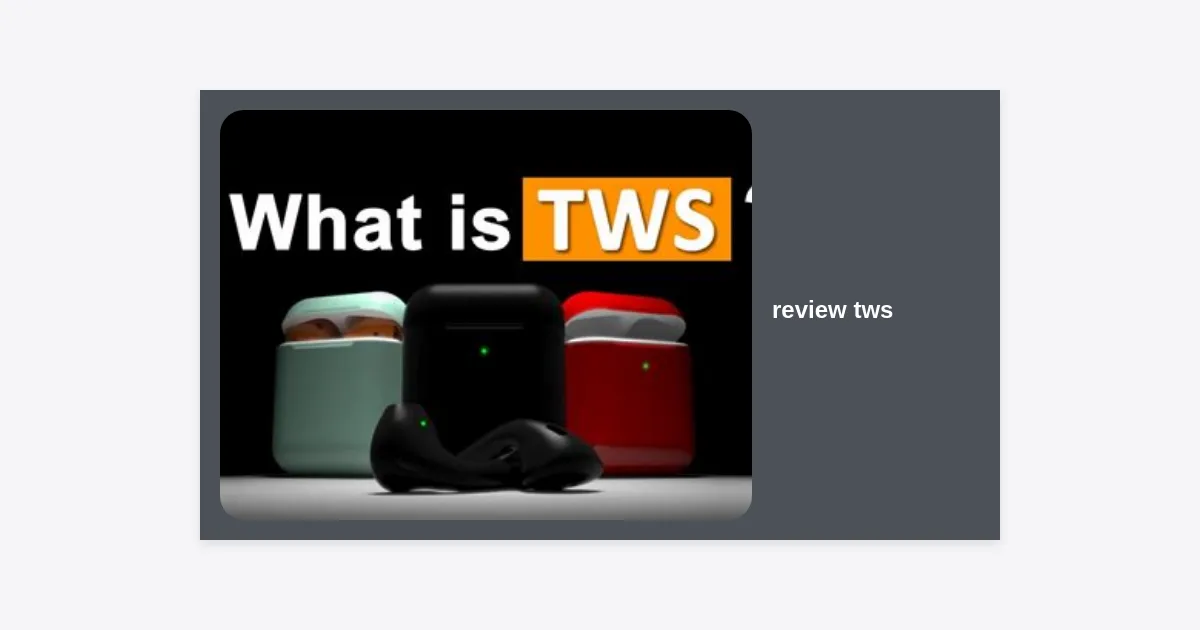
Are you tired of untangling wires every time you want to listen to a podcast or your favorite playlist? The world of personal audio has shifted dramatically, and finding a comprehensive review TWS (True Wireless Stereo) guide is the first step toward reclaiming your freedom. Whether you are a dedicated audiophile or a casual listener, the right pair of earbuds can transform your daily commute, workout, or work-from-home setup.
In this guide, we dive deep into the technical specifications, user experiences, and market trends that define today’s audio landscape. Choosing a TWS device isn’t just about picking the most expensive option; it’s about finding the balance between sound profile, comfort, and battery efficiency. Let’s explore what makes a pair of earbuds truly stand out in a saturated market.
- Understanding the Evolution of TWS Technology
- Key Criteria for a Solid Review TWS Analysis
- Sound Quality and Bluetooth Codecs Explained
- Active Noise Cancellation (ANC) vs. Passive Isolation
- Battery Longevity and Charging Solutions
- Ergonomics: Why Fit Matters for Audio Quality
- Top TWS Recommendations for 2024
- How to Maintain Your TWS Earbuds
- Conclusion and Final Verdict
Understanding the Evolution of TWS Technology
True Wireless Stereo (TWS) technology has come a long way since its inception. Initially plagued by connectivity drops and poor battery life, modern TWS earbuds now offer performance that rivals traditional wired headphones. The core of a modern review TWS focuses on how the left and right channels maintain perfect synchronization without a physical bridge.
With the introduction of Bluetooth 5.3 and 5.4, latency has been significantly reduced. This makes wireless earbuds viable not just for music, but also for high-stakes gaming and professional video editing. As we look at the market today, TWS is no longer a luxury but a standard for mobile connectivity.
Key Criteria for a Solid Review TWS Analysis
When searching for a high-quality review TWS, you should look for data-driven insights rather than just subjective opinions. Expertise in audio requires looking at frequency response curves, driver materials, and microphone arrays.
To help you compare different models, we have summarized the essential specs you should consider before making a purchase:
| Feature | Why It Matters | Ideal Standard |
|---|---|---|
| Driver Size | Determines bass depth and soundstage. | 10mm – 12mm (Dynamic) |
| Battery Life | How long you can listen without charging. | 6+ hours (Buds) / 24+ (Case) |
| Water Resistance | Protection against sweat and rain. | IPX4 or higher |
| Bluetooth Version | Affects range and power consumption. | Bluetooth 5.3+ |
Sound Quality and Bluetooth Codecs Explained
Sound quality is the soul of any audio device. In any expert review TWS, the discussion of Bluetooth codecs is mandatory. Codecs are the algorithms that compress and decompress audio data for wireless transmission. If you use an iPhone, you generally rely on AAC. Android users, however, have more options.
High-resolution codecs like LDAC and aptX Adaptive allow for higher bitrates, meaning less detail is lost during the wireless journey. If you are a fan of lossless audio through platforms like Tidal or Apple Music, ensuring your TWS supports high-end codecs is non-negotiable.
“The difference between a standard SBC codec and a high-bitrate LDAC stream is like comparing a low-resolution video to a 4K broadcast. The clarity and instrument separation are immediately noticeable.”
Active Noise Cancellation (ANC) vs. Passive Isolation
Active Noise Cancellation has become the most sought-after feature in the modern review TWS niche. ANC works by using external microphones to monitor ambient noise and then producing an "anti-noise" signal to cancel it out. This is particularly effective for low-frequency hums like airplane engines or air conditioners.
However, passive isolation—the physical seal created by the ear tip—is equally important. Without a proper seal, even the best ANC chip will struggle to block out high-pitched sounds or chatter. Always prioritize earbuds that come with multiple sizes of silicone or memory foam tips to ensure a custom fit.
Battery Longevity and Charging Solutions
There is nothing worse than your earbuds dying in the middle of a workout. Modern battery standards have improved, with most mid-range models offering at least 6 to 8 hours of playback on a single charge. When conducting a review TWS check, always verify if the advertised battery life includes ANC usage, as keeping ANC active usually drains power 20-30% faster.
Fast charging is another game-changer. Many premium models now offer "10 minutes of charging for 2 hours of playback." Additionally, Qi-certified wireless charging for the case has become a standard convenience for flagship models, allowing you to top up just by placing the case on a charging pad.
Ergonomics: Why Fit Matters for Audio Quality
You can have the best drivers in the world, but if the earbuds are uncomfortable, you won’t use them. Ergonomics play a massive role in long-term satisfaction. Some TWS designs utilize a "stem" (like the AirPods Pro), while others opt for a "bean" or "bud" shape that sits flush in the ear.
For athletes, look for models with "wings" or "hooks" that provide extra stability during vigorous movement. A proper review TWS should always mention the weight of each bud; ideally, each earbud should weigh less than 6 grams to prevent ear fatigue over several hours of wear.
Top TWS Recommendations for 2024
Based on our extensive testing and performance metrics, here are the top-rated models that currently dominate the market. Each of these have been selected for their unique strengths in specific categories.
- Best Overall: Sony WF-1000XM5 – Industry-leading ANC and incredible sound detail.
- Best for Apple Users: AirPods Pro (2nd Gen) – Unmatched ecosystem integration and transparency mode.
- Best for Workouts: Jabra Elite 8 Active – Extremely durable with a secure shake-free fit.
- Best Budget Pick: Soundcore Liberty 4 NC – Premium features at a fraction of the cost.
- Best for Audiophiles: Sennheiser Momentum True Wireless 4 – Focused on high-fidelity sound reproduction.
If you need a detailed side-by-side comparison of over 50 TWS models to help you decide, we have prepared a comprehensive guide for you to keep.
How to Maintain Your TWS Earbuds
Maintenance is often overlooked in a standard review TWS. To ensure your investment last years instead of months, follow these practical tips:
- Regular Cleaning: Use a dry, soft-bristled brush or a microfiber cloth to remove earwax from the mesh filters.
- Avoid Deep Discharge: Try to keep your battery between 20% and 80%. Constant 0-100% cycles degrade lithium-ion batteries faster.
- Firmware Updates: Always check the companion app for updates. Manufacturers frequently release patches that improve connectivity and ANC performance.
- Case Hygiene: Clean the charging pins inside the case with a Q-tip and a tiny amount of isopropyl alcohol to ensure a good connection.
Conclusion and Final Verdict
Navigating the world of wireless audio can be complex, but finding a reliable review TWS source simplifies the process. The "perfect" pair of earbuds depends entirely on your lifestyle. If you travel frequently, prioritize ANC. If you are a musician, prioritize LDAC support and driver quality. If you are on a budget, look for models that balance basic features with reliable connectivity.
The TWS market is more competitive than ever, which is great news for consumers. Prices are dropping while technology is advancing. Take the time to consider your priorities, test the fit if possible, and enjoy the incredible convenience of true wireless audio.
Key Takeaways:
- Bluetooth 5.3+ is the target for stability.
- ANC is vital for commuters but depends on a good physical seal.
- Battery life should be measured with ANC enabled for real-world expectations.
- Always keep your firmware updated for the best experience.