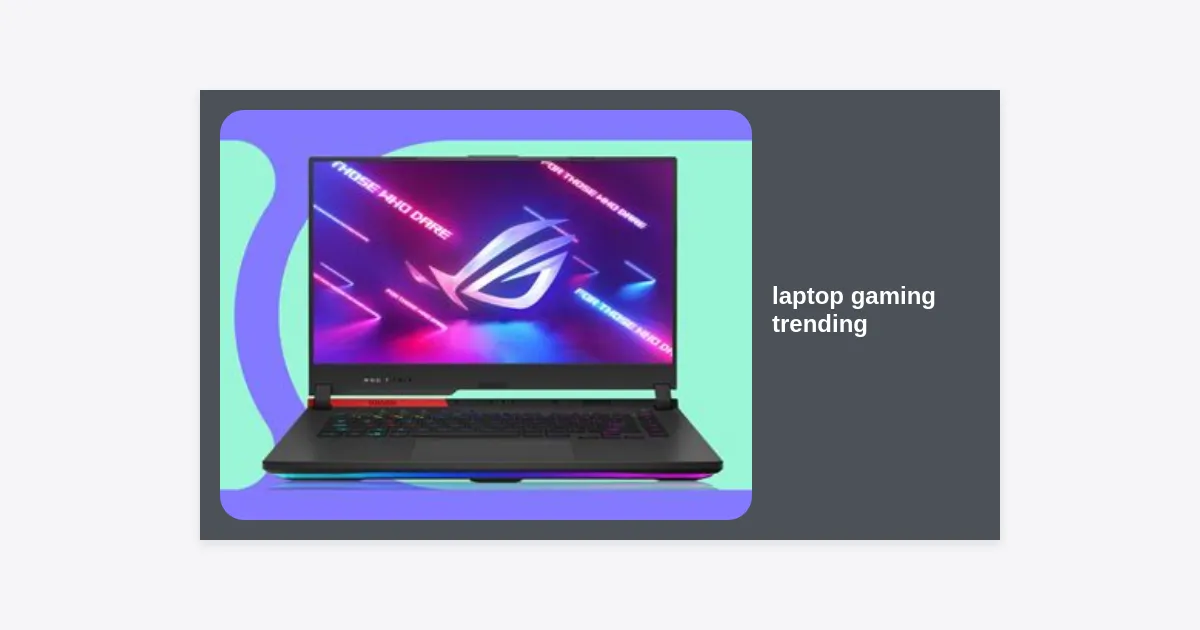
In the rapidly evolving world of technology, keeping up with laptop gaming trending topics is essential for any serious gamer or professional looking for portable power. Whether you are a competitive esports player or a creative professional who games on the side, the current landscape of gaming laptops has shifted dramatically from bulky behemoths to sleek, high-refresh-rate powerhouses that rival many desktop counterparts.
Table of Contents
Current Trends in the Gaming Laptop Market
The laptop gaming trending sphere is currently dominated by two major movements: extreme portability and desktop-level performance. Manufacturers are no longer content with just packing the fastest chips into thick chassis; they are engineering thermal solutions that allow ultra-thin laptops to run flagship GPUs.
One of the most significant shifts we have observed is the rise of the “Thin-and-Light” gaming segment. Brands like ASUS with their Zephyrus line and Razer with the Blade series have proven that you can have a machine under 20mm thick that still shreds through AAA titles at 1440p resolution.
Another major trend is the integration of 16:10 aspect ratio screens. This small change provides more vertical screen real estate, which is excellent for both productivity and more immersive gaming experiences. It reflects a growing desire for “hybrid” machines that serve both work and play effectively.
The Surge of Esports-Ready Displays
Competitive gaming has driven the demand for refresh rates that were unthinkable five years ago. We are now seeing the laptop gaming trending toward 240Hz and even 360Hz displays as standard on high-end models. This isn’t just marketing fluff; for gamers playing titles like Counter-Strike 2 or Valorant, the reduced input lag and smoother motion tracking provide a tangible competitive advantage.
Hardware Breakdown: What’s Under the Hood
When discussing laptop gaming trending hardware, we must look at the silicon. Currently, the market is defined by NVIDIA’s RTX 40-series and Intel’s 14th Gen or Core Ultra processors, alongside AMD’s powerful Ryzen 8000 and 9000 series chips.
The NVIDIA GeForce RTX 4090 and 4080 Mobile GPUs have redefined what is possible. Using the Ada Lovelace architecture, these chips utilize DLSS 3.5 (Deep Learning Super Sampling) and Frame Generation to boost frame rates significantly without a massive increase in power consumption. This efficiency is why we see such powerful laptops becoming smaller.
- NVIDIA DLSS 3.5: Uses AI to create additional frames and improve ray-tracing quality.
- Intel Core Ultra: Integrates dedicated NPUs (Neural Processing Units) for AI tasks, freeing up the CPU for gaming.
- DDR5 RAM: Most trending laptops now ship with at least 16GB of DDR5-5600MHz memory, ensuring zero bottlenecks.
“The transition from DDR4 to DDR5 has provided a 50% increase in bandwidth, which is pivotal for open-world games that stream large amounts of data from the SSD to the GPU.”
The Standardized Use of Gen4 and Gen5 SSDs
Loading screens are becoming a relic of the past. With PCIe Gen4 SSDs being the minimum standard in laptop gaming trending lists, and Gen5 starting to appear, sequential read speeds are exceeding 7,000 MB/s. This fast storage is critical for Windows 11’s DirectStorage API, which allows GPUs to fetch data directly from the drive.
Display Technology: Beyond 1080p
While 1080p used to be the gold standard, the laptop gaming trending toward QHD (1440p) and 4K is undeniable. However, the real story isn’t just resolution—it’s the panel technology itself. Mini-LED and OLED are the new kings of the hill.
Mini-LED displays offer incredible brightness, often exceeding 1,000 nits, making them HDR-ready. They use thousands of tiny LEDs to provide local dimming, resulting in deep blacks that rival OLED without the risk of burn-in. On the other hand, OLED panels provide near-instantaneous response times (0.03ms), which is a dream for fast-paced action.
Thermal Management and Cooling Innovations
Heat is the enemy of performance. To keep up with laptop gaming trending power demands, manufacturers have had to get creative. We are seeing more widespread use of liquid metal thermal compounds instead of traditional grease, which can lower CPU temperatures by up to 10-15 degrees Celsius.
Vapor chamber cooling has also become more common in mid-range to high-end laptops. Unlike traditional heat pipes, vapor chambers spread heat across a wider surface area, allowing for much more efficient dissipation. Some manufacturers like ASUS have even introduced “Tri-Fan” technology to direct airflow specifically toward the GPU and VRMs.
The Role of AI in Modern Gaming Laptops
In 2024, AI isn’t just a buzzword; it’s a core component of the laptop gaming trending narrative. AI is used to manage power distribution dynamically between the CPU and GPU (e.g., NVIDIA Dynamic Boost). If a game is heavily GPU-bound, the AI will shift more wattage to the graphics card to maximize frames.
Furthermore, AI-powered noise cancellation for microphones and auto-framing for webcams have become standard features, catering to the massive demographic of gamers who also stream on platforms like Twitch and YouTube.
How to Choose the Right Rig for Your Budget
Navigating the sea of options in the laptop gaming trending market can be daunting. Here is a quick breakdown of what you should expect at different price points:
| Budget Range | Target Specs | Ideal Use Case |
|---|---|---|
| Entry-Level ($700 – $900) | RTX 4050, 16GB RAM, 144Hz FHD | Esports (Fortnite, LoL), 1080p Medium settings |
| Mid-Range ($1,200 – $1,600) | RTX 4070, 16GB/32GB RAM, 165Hz QHD | AAA games at High settings, content creation |
| High-End ($2,500+) | RTX 4080/4090, 64GB RAM, Mini-LED/OLED | 4K Gaming, Professional Video Editing, VR |
Pro Tip: Always look for the “TDP” or TGP (Total Graphics Power) of the GPU. An RTX 4060 with a high TGP (140W) can sometimes outshine an RTX 4070 that is power-constrained (60W-80W) in a thinner chassis.
Future Outlook and Conclusion
The laptop gaming trending trajectory is clear: more AI, better efficiency, and displays that blur the line between reality and digital. As we look toward late 2024 and 2025, we expect to see the first glimpses of the RTX 50-series (Blackwell) mobile chips and even more integration of cloud gaming services as a fallback for lower-powered devices.
If you are looking to buy now, focus on a machine that offers a balanced thermal design and a high-quality screen. Hardware will always be superseded, but a great display and a reliable chassis will last you years.
Looking for a Laptop Comparison Spreadsheet?
Stay ahead of the 2024 market trends with our curated buyer’s guide and spec comparison sheet.
In conclusion, the laptop gaming trending scene is more vibrant than ever. By focusing on the latest in GPU efficiency, display quality, and thermals, you can ensure your next investment provides an incredible gaming experience for years to come. Whether you’re chasing high frame rates in competitive shooters or cinematic immersion in RPGs, there has never been a better time to be a PC gamer on the go.