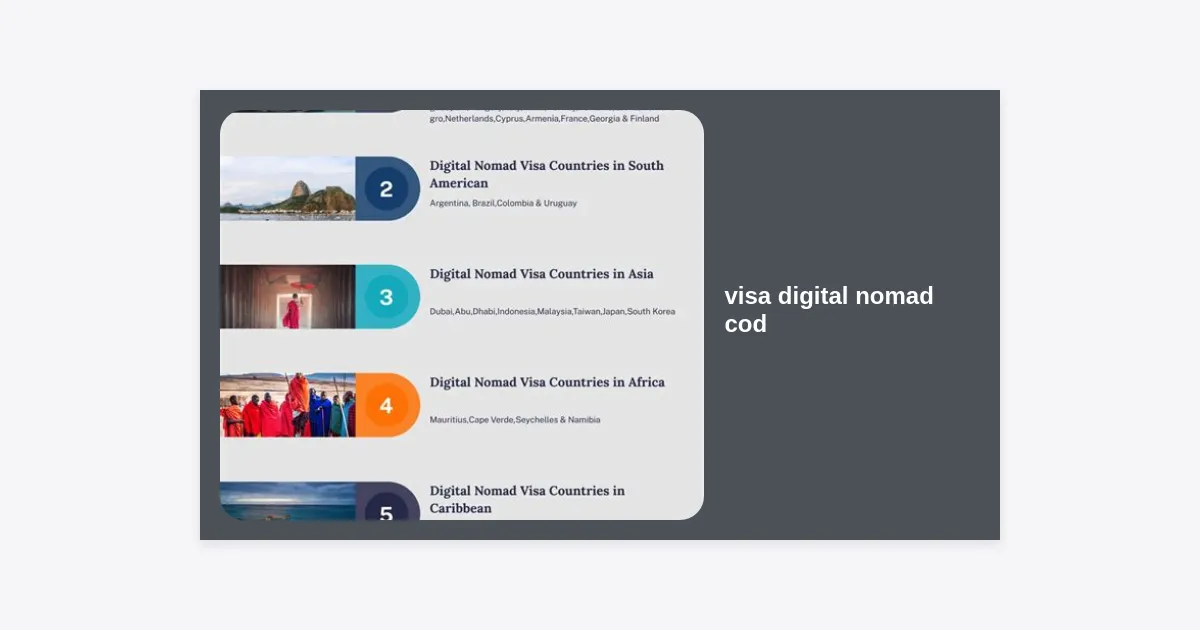
Are you tired of the traditional 9-to-5 office grind and dreaming of working from a sun-drenched beach or a cozy mountain café? The rise of the remote workforce has revolutionized how we view our careers, leading to the emergence of the visa digital nomad cod—a specialized regulatory framework designed to accommodate the needs of modern remote professionals. Navigating the world of international immigration can be daunting, but understanding the specific visa digital nomad cod documentation and tax implications is the first step toward achieving ultimate location independence.
Whether you are a freelance programmer, a digital marketer, or a consultant, the ability to legally reside and work in a foreign country is no longer a bureaucratic nightmare. In this comprehensive guide, we will break down the complexities of the visa digital nomad cod, explore the most sought-after destinations, and provide you with an actionable roadmap to launching your life as a global citizen.
Table of Contents
- What is the Visa Digital Nomad COD?
- Eligibility Criteria for Remote Workers
- Essential Documentation and the COD Framework
- Step-by-Step Application Process
- Understanding the Tax Code (COD) for Nomads
- Top Destinations with Emerging Visa COD Programs
- Financial Thresholds and Proof of Income
- Common Challenges and Expert Tips
- Free Resources and Checklists
- Conclusion: Your Future Starts Today
What is the Visa Digital Nomad COD?
The term visa digital nomad cod refers to the specific legislative and regulatory code segments that nations use to define the rights, responsibilities, and tax statuses of remote workers. Unlike traditional work permits that require a local employer, the digital nomad visa (DNV) is built on the principle of “foreign income source.” This means you live in Country A while being paid by a company or clients located in Country B.
The “COD” often stands for the Class of Deployment or the Code of Designation within immigration databases. Historically, travelers had to rely on tourist visas, which often forbade any form of work. However, the visa digital nomad cod provides a legal bridge, allowing you to stay for extended periods (typically 1 to 2 years) with the option to renew. This legal clarity is essential for avoiding issues with local labor laws and ensuring you have access to local services like healthcare and banking.
Eligibility Criteria for Remote Workers
Before you pack your bags, you must ensure you meet the strict criteria set by the visa digital nomad cod guidelines. While every country has its unique nuances, most follow a standardized set of requirements to ensure that applicants are self-sufficient and won’t burden the local social security systems.
1. Remote Work Verification
You must prove that your work can be performed entirely online. This typically requires a letter from your employer or, if you are a business owner, articles of incorporation. The visa digital nomad cod requires proof that your clients or company are located outside the host country’s borders.
2. The Clean Record Requirement
Security is paramount. Most nations requiring a visa digital nomad cod application will ask for a nationwide criminal background check. This document usually needs to be apostilled or legalized by the issuing country and must be dated within 3 to 6 months of your application.
3. Professional Experience
Some more competitive jurisdictions may require proof of a specific educational background or a minimum number of years in your field. This is to ensure that you are a high-value contributor to the local economy through your indirect spending.
Essential Documentation and the COD Framework
To successfully obtain a visa digital nomad cod, you must curate a robust application portfolio. Missing even a single document can result in an immediate rejection or long delays in processing. Below are the most common documents requested under the international nomad code:
- Valid Passport: Must have at least 6-12 months of validity remaining.
- Proof of Income: Bank statements, tax returns, or payslips showing you meet the monthly threshold.
- Health Insurance: Comprehensive international coverage that includes repatriation and a high coverage limit.
- Accommodation Proof: A rental agreement or a letter of intent for local housing.
- COD Application Fee: Receipts showing the payment of processing fees (ranging from $100 to $2,000 depending on the country).
“The digital nomad visa is not just a permit; it is a gateway to a new lifestyle that balances cultural immersion with professional productivity.” — Global Mobility Expert
Step-by-Step Application Process
Applying for a visa digital nomad cod once you have your documents ready follows a generally predictable path, though the medium (online vs. in-person) varies. Here is a typical timeline:
- Initial Consultation: Check the official embassy website or the Ministry of Interior portal for the specific requirements of the digital nomad code in your target country.
- Document Preparation: Gather, translate, and apostille all necessary paperwork. This stage often takes the longest (up to 2 months).
- Submission: Many modern digital nomad programs allow for online submission through a dedicated portal. In some cases, you may need to visit a VFS Global center or an embassy.
- Interview: Some countries, like Croatia or Portugal, may require a brief interview to verify your remote work status and intentions.
- Wait for Approval: Processing times vary wildly. Spain and Greece often process within 20 days, while others might take 3 to 6 months.
- Biometric Collection: Once approved, you will travel to the country (if not already there on a tourist visa) to provide fingerprints and photos for your physical ID card.
Understanding the Tax Code (COD) for Nomads
Taxation is the most complex aspect of the visa digital nomad cod. One common misconception is that because you are on a nomad visa, you don’t owe taxes anywhere. This is a dangerous myth that can lead to heavy fines or deportation.
Most countries use a 183-day rule. If you spend more than 183 days within a calendar year in a country, you are typically considered a tax resident. However, many visa digital nomad cod programs offer special tax breaks. For instance:
- Tax Holidays: Some countries, like Greece, offer a 50% income tax reduction for the first few years.
- Flat Tax Rates: Countries like Estonia allow you to remain a tax resident of your home country while working there on a DNV, provided certain conditions are met.
- Non-Habitual Resident Schemes: Though changing, Portugal has historically offered the NHR scheme which provides significant relief on foreign-sourced income.
Integrating the visa digital nomad cod into your financial planning is vital. We highly recommend consulting with a cross-border tax specialist before making your move official.
Top Destinations with Emerging Visa COD Programs
The market for remote work visas is highly competitive. Let’s look at some of the most popular visa digital nomad cod programs available today:
| Country | Monthly Income Req. | Visa Duration | Unique Selling Point |
|---|---|---|---|
| Spain | €2,646+ | 1 Year (Renewable for 3) | Direct path to permanent residency |
| Portugal (D8) | €3,280+ | 1-2 Years | Excellent tech hubs in Lisbon and Porto |
| Costa Rica | $3,000+ | 1 Year | No local income tax for nomads |
| United Arab Emirates | $3,500+ | 1 Year | Zero personal income tax |
Financial Thresholds and Proof of Income
The core of the visa digital nomad cod is the financial threshold. Governments want to ensure you have enough money to support yourself without competing for local jobs. This threshold is usually based on a percentage of the national minimum wage.
When providing proof of income, consistency is key. Erratic freelance income can be a red flag. If your income varies, provide a 12-month average that exceeds the requirement by at least 15-20%. The visa digital nomad cod guidelines often allow for a combination of savings and income to meet the requirements, provided you have a high enough liquid balance (usually $20,000 to $50,000).
Common Challenges and Expert Tips
Even with a visa digital nomad cod in hand, living abroad is not without its hurdles. Here are three major challenges and how to overcome them:
1. Housing Scams: Many nomads are targeted by fake rental listings. Always use reputable platforms like Airbnb for your first month and search for long-term rentals only after you are on the ground and can view properties in person.
2. Social Isolation: Working from home in a foreign country can be lonely. Join local coworking spaces or “Digital Nomad” Facebook groups even before you arrive to build a community.
3. Internet Reliability: While the visa digital nomad cod focuses on the legal side, you must focus on the technical side. Always verify the upload/download speeds of your accommodation and have a backup mobile hotspot or satellite internet solution.
Free Resources and Checklists
To help you stay organized during this life-changing transition, we have developed a comprehensive preparation kit. This includes a document tracker, a budget calculator, and a country comparison matrix.
Note: If the link above does not open, please check your browser’s download settings and search for the “International Nomad Visa COD Prep-Kit” in our resource library.
Conclusion: Your Future Starts Today
Securing a visa digital nomad cod is more than just a legal necessity; it is an investment in your personal growth and professional freedom. By understanding the underlying code of these visas—from the strict financial requirements to the generous tax incentives—you can navigate the application process with confidence.
Key Takeaways:
- The visa digital nomad cod is a specific legal framework for remote work.
- Financial self-sufficiency is the primary requirement for most programs.
- Always prepare for the tax implications of living abroad longer than 6 months.
- Start your documentation early, especially for background checks and apostilles.
Are you ready to stop dreaming and start doing? Choose your destination, verify your eligibility against the latest visa digital nomad cod standards, and take the first step toward a life without borders. The world is waiting for you.