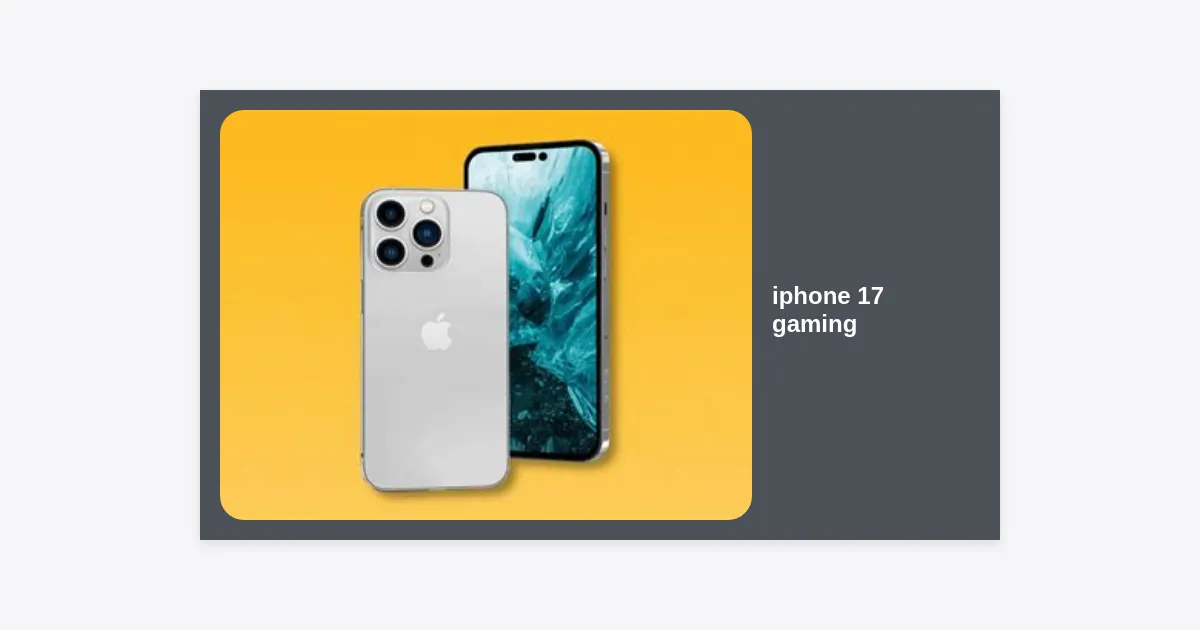
Is the future of console gaming already in your pocket? With the upcoming release of the next generation of Apple devices, iPhone 17 gaming is poised to bridge the gap between mobile portability and high-fidelity desktop experiences. As mobile hardware evolves, staying ahead of the curve is essential for competitive players and casual enthusiasts alike.
Table of Contents
- The Evolution of iPhone Gaming
- iPhone 17 Gaming Hardware: Rumors and Realities
- The A19 Bionic: A Leap in Processing Power
- ProMotion and Visual Fidelity
- Thermal Management: Gaming Without the Burn
- iOS 19 and Game Mode Enhancements
- The Rise of AAA Titles on Mobile
- Essential Accessories for iPhone 17 Gamers
- iPhone 17 vs. Dedicated Gaming Handhelds
- Optimization Tips for Maximum FPS
- Conclusion: Is the iPhone 17 the Ultimate Gaming Phone?
The Evolution of iPhone Gaming
Only a decade ago, mobile gaming was synonymous with simple puzzles and 2D sprites. However, the landscape has shifted dramatically. Today, iPhone 17 gaming represents the culmination of years of iterative development in silicon architecture and software optimization.
Apple has gone from being a casual gaming platform to a serious contender in the core gaming space. With the introduction of hardware-accelerated ray tracing in previous models, the foundation is set for the iPhone 17 to push the boundaries of what we thought possible on a handheld device. The integration of Apple Silicon across their entire ecosystem means developers can port massive titles with more ease than ever before.
iPhone 17 Gaming Hardware: Rumors and Realities
To understand the potential of iPhone 17 gaming, we must look at the physical components. Rumors suggest that the iPhone 17 series will feature a more robust internal cooling structure and expanded RAM capacities to handle the increasing demands of modern game engines like Unreal Engine 5.
Industry analysts expect the iPhone 17 Pro models to ship with at least 12GB of RAM. This is a crucial upgrade for gamers, as high-resolution textures and complex physics calculations require substantial memory overhead. This extra room allows for more seamless multitasking and prevents game crashes during intense sessions.
The A19 Bionic: A Leap in Processing Power
At the heart of the iPhone 17 gaming experience is the A19 Bionic chip. Built on a cutting-edge 2nm process, this chip is designed to deliver significantly higher performance-per-watt than its predecessors. This means faster frame rates and lower battery consumption, a win-win for any gamer.
“The transition to 2nm technology allows for a higher density of transistors, enabling more complex GPU cores that can handle real-time global illumination and enhanced shadow mapping without breaking a sweat.”
The A19 is expected to feature a 6-core GPU specifically optimized for Metal 3. This allows for features like MetalFX Upscaling, which functions similarly to NVIDIA’s DLSS, providing high-quality visuals while keeping the frame rate stable and smooth.
ProMotion and Visual Fidelity
Visuals are the gateway to immersion. The iPhone 17 gaming experience is elevated by the rumored inclusion of an upgraded ProMotion display. While 120Hz is the current standard, there is speculation that Apple might push the refresh rate even further or improve the variable refresh rate (VRR) range to save battery during static scenes while providing ultra-smooth motion during gameplay.
Furthermore, the peak brightness is expected to reach new heights, potentially hitting 2500-3000 nits. This makes gaming in direct sunlight not just possible, but enjoyable, as the contrast ratios will keep HDR content looking vibrant regardless of the environment.
Thermal Management: Gaming Without the Burn
One of the biggest hurdles in mobile gaming is thermal throttling. When a device gets too hot, it slows down to protect its hardware, resulting in dropped frames. For the iPhone 17 gaming lineup, Apple is reportedly experimenting with graphene thermal sheets or even vapor chamber cooling for the Pro Max variants.
Proper heat dissipation ensures that during a 2-hour session of Genshin Impact or Call of Duty: Warzone Mobile, your performance remains consistent. Improved thermals also increase the longevity of the battery, as heat is the primary enemy of lithium-ion health.
iOS 19 and Game Mode Enhancements
Hardware is only half the battle; software is what brings it to life. iOS 19 is expected to refine “Game Mode,” a feature that prioritizes CPU and GPU resources for the active game while minimizing background activity. For iPhone 17 gaming, this could mean even lower latency for Bluetooth controllers and AirPods.
- Intelligent Resource Allocation: Automatically silencing notifications and freeing up RAM.
- Lower Input Lag: Optimized polling rates for external peripherals.
- Enhanced Game Center: Better social integration and cross-play management.
The Rise of AAA Titles on Mobile
The success of titles like Resident Evil Village and Death Stranding on the iPhone 15 Pro paved the way. iPhone 17 gaming will likely see an explosion of “Console-to-Mobile” ports. We are no longer looking at “mobile versions” of games but the actual full-fledged titles running natively on your phone.
Developers like Capcom, Ubisoft, and Kojima Productions have already shown interest in Apple’s ecosystem. With the A19’s power, we can expect games originally designed for the PS5 and Xbox Series X to find a home on the iPhone 17 Pro, complete with ray-traced reflections and high-fidelity textures.
Essential Accessories for iPhone 17 Gamers
To truly unlock the potential of iPhone 17 gaming, you need the right gear. Touchscreens are great for casual play, but for competitive gaming, physical controls are king.
- Mobile Controllers: Look for the BackBone One or Razer Kishi Ultra, which offer USB-C connectivity for zero-latency input.
- MagSafe Cooling Fans: If you play demanding titles, a MagSafe-compatible cooler can help maintain peak performance.
- High-Speed Power Banks: Ensure you have a PD (Power Delivery) compatible battery pack to keep your device charged during long tournaments.
iPhone 17 vs. Dedicated Gaming Handhelds
Is the iPhone 17 a legitimate replacement for a Nintendo Switch or a Steam Deck? Let’s look at the comparison:
| Feature | iPhone 17 (Pro Rumored) | Steam Deck / ROG Ally |
|---|---|---|
| Portability | Extreme (Fits in pocket) | Moderate (Needs a case/bag) |
| Display | 120Hz+ OLED (High DPI) | 7-8″ IPS or OLED (Lower DPI) |
| Library | App Store + Growing AAA Ports | Massive (Steam/Windows Library) |
| Battery Life | Long (Optimized Silicon) | Short (1.5 – 3 hours on AAA) |
Optimization Tips for Maximum FPS
If you want to ensure your iPhone 17 gaming experience is as smooth as possible, follow these actionable tips:
- Enable Game Mode: Ensure this is active in your settings to give your game top priority.
- Clear Background Apps: Before launching a heavy title, swipe away apps you aren’t using.
- Manage Storage: Keep at least 15-20% of your storage free. SSDs slow down when nearly full, which can affect loading times and asset streaming.
- Ambient Temperature: Play in a cool environment to delay the onset of thermal throttling.
Conclusion: Is the iPhone 17 the Ultimate Gaming Phone?
In conclusion, iPhone 17 gaming isn’t just a minor update; it’s a paradigm shift. With the A19 chip, expanded RAM, and more sophisticated thermal management, Apple is building a device that challenges the very definition of a “mobile game.”
Key Takeaways:
- The A19 Bionic will be the primary driver of performance, enabling console-level graphics on a mobile device.
- Hardware Ray Tracing and AI-driven upscaling will make games look better than ever.
- Thermal improvements will allow for longer, more stable gaming sessions.
Whether you are a professional esports player or someone who just wants to enjoy a cinematic story on your commute, the iPhone 17 is shaping up to be the most powerful tool in your arsenal. The future of gaming is mobile, and it’s arriving sooner than you think.