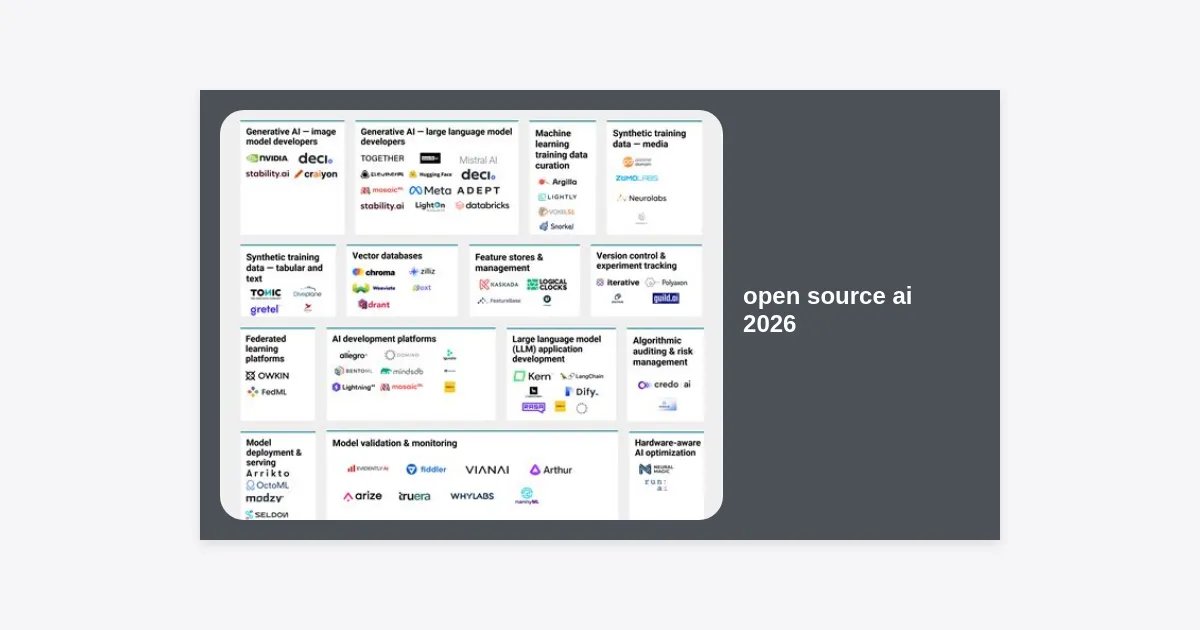
By the time we reach open source ai 2026, the landscape of technology will have shifted from the centralized control of a few tech giants to a democratized, community-driven ecosystem. Imagine a world where the most powerful intelligence on the planet isn’t locked behind a proprietary API, but is accessible, modifiable, and deployable by anyone with a vision. This transition is not just a trend; it is a fundamental shift in how humanity interacts with machine logic. In this comprehensive guide, we explore the trends, tools, and strategies that will define the era of open source ai 2026 and beyond.
Table of Contents
- The Great Shift: Why 2026 is the Year of Open Source AI
- Top Trends Shaping Open Source AI in 2026
- Small Language Models (SLMs) and Edge Intelligence
- Decentralized Compute: Powering the Revolution
- Actionable Strategies for Businesses in 2026
- Open Source vs. Closed Source: The 2026 Verdict
- Ethics, Privacy, and Security in the Open Ecosystem
- Conclusion and Key Takeaways
The Great Shift: Why 2026 is the Year of Open Source AI
As we look toward the horizon of open source ai 2026, it is clear that the “moat” once held by proprietary LLM providers has evaporated. In 2023 and 2024, the tech world was obsessed with massive models like GPT-4. However, the innovation cycle has accelerated to a point where community-driven models now match or exceed the performance of their closed-source counterparts in 90% of real-world applications.
Several factors have converged to make 2026 the tipping point. First, the cost of training high-quality foundation models has plummeted due to better algorithmic efficiency. Second, the “data wall” hit by many large labs has leveled the playing field, as open-source researchers find creative ways to utilize synthetic data and high-quality curated datasets.
Most importantly, the global demand for data sovereignty has skyrocketed. Corporations and governments are no longer comfortable sending their most sensitive data to third-party endpoints. They are turning to open source ai 2026 solutions to keep their intelligence stacks in-house, secure, and fully auditable.
“The future of AI is not in a single monolithic brain, but in a millions of specialized, open-source neurons distributed across the globe.” — Industry Projection, 2025.
Top Trends Shaping Open Source AI in 2026
To understand open source ai 2026, one must look at the technical trends that have matured over the last few years. We are no longer just talking about chatbots; we are talking about autonomous agents, multimodal systems, and embedded intelligence.
1. Native Multimodality
By 2026, the standard open-source model is no longer just a text processor. It is natively multimodal, meaning it understands and generates images, audio, and video as fluently as it does text. This allows for seamless transitions in tasks—from analyzing a legal document to generating a video briefing of its key points.
2. Agentic Frameworks
The focus has shifted from “inference” to “execution.” Open source frameworks like AutoGPT and LangChain have evolved into robust, enterprise-grade systems where AI agents can interact with software, perform browser-based tasks, and collaborate with other AIs without human intervention.
3. Modular and Mixture-of-Experts (MoE)
The architectural dominance of Mixture-of-Experts (MoE) in the open-source community allows for massive models that only activate a fraction of their parameters for any given task. This makes open source ai 2026 models incredibly fast and cheap to run on standard hardware.
Small Language Models (SLMs) and Edge Intelligence
One of the most significant shifts in the open source ai 2026 era is the rise of the Small Language Model (SLM). While the 2020s began with a “bigger is better” mentality, 2026 is defined by specialized efficiency.
- On-Device Performance: Models with 3B to 7B parameters now outperform the original GPT-3.5, allowing them to run locally on smartphones and laptops.
- Latency: By eliminating the need for a round-trip to the cloud, SLMs offer near-zero latency, which is critical for gaming, real-time translation, and robotics.
- Fine-Tuning: It is now possible to fine-tune a small, open-source model on a single consumer GPU in a matter of hours, making niche specialization accessible to small businesses.
Statistical data from 2025 indicated that 70% of enterprise AI tasks could be completed more efficiently by a specialized SLM than by a general-purpose LLM. This trend has reached full maturity in the 2026 landscape.
Decentralized Compute: Powering the Revolution
A major bottleneck for open source ai 2026 was always compute power. However, the rise of decentralized compute networks has solved this problem. Projects that utilize blockchain and peer-to-peer protocols allow developers to tap into idle GPU power from across the world.
This “Airbnb for GPUs” model has slashed the cost of training and hosting open-source models by over 60%. Not only does this make AI more affordable, but it also creates a resilient infrastructure that cannot be shut down by a single corporate or political entity.
Actionable Strategies for Businesses in 2026
If you are an executive or an entrepreneur looking to leverage open source ai 2026, you need a concrete roadmap. This isn’t just about downloading a model; it’s about building a sustainable intelligence stack.
Step 1: Audit Your Data Pipeline
Your AI is only as good as the data it’s trained on. Start by cleaning and structuring your proprietary data. In 2026, the value is not in the model—which is a commodity—but in the unique data you use to fine-tune it.
Step 2: Choose the Right Foundation
Don’t default to the largest model. Identify the specific needs of your application. If you need speed and privacy, look at the latest iterations of Llama, Mistral, or the emerging Falcon family. Use specialized models for coding, medical analysis, or creative writing.
Step 3: Implement Local Infrastructure
Invest in local hosting or private cloud solutions. Tools like vLLM and Ollama have made it easy to serve open source ai 2026 models locally with high throughput. This ensures you maintain control over your intellectual property.
Step 4: Adopt a Hybrid Approach
The most successful companies in 2026 use a hybrid model. They use closed-source APIs for rapid prototyping and non-sensitive tasks, while migrating their core, mission-critical operations to optimized open-source models.
Open Source vs. Closed Source: The 2026 Verdict
The debate between open and closed source has evolved. In 2026, it is no longer about which is “better” in a vacuum, but which is more appropriate for specific use cases.
| Feature | Open Source AI 2026 | Closed Source AI 2026 |
|---|---|---|
| Cost | Low (In-house/Decentralized) | High (Subscription/Token-based) |
| Privacy | Total (On-premise possible) | Limited (Data sent to provider) |
| Customization | Deep (Full weights control) | Surface (Prompting/Limited FT) |
| Innovation Speed | Rapid (Global community) | Moderate (Corporate roadmap) |
| Ease of Use | Requires technical skill | Plug-and-play |
While closed-source models still hold a slight edge in “frontier” reasoning capabilities, the gap is so narrow that for most commercial applications, open source ai 2026 is the more logical choice for long-term scalability and cost-effectiveness.
Ethics, Privacy, and Security in the Open Ecosystem
With great power comes great responsibility. The open source ai 2026 movement faces significant challenges regarding safety and alignment. Without a central gatekeeper, the risk of bad actors using AI for disinformation or cyberattacks is real.
However, the open-source community has responded with “Open Safety” protocols. These are community-vetted guardrails that are baked into the models during the fine-tuning process. Furthermore, the transparency of open source allows for “crowdsourced red-teaming,” where thousands of researchers can identify and patch vulnerabilities faster than any single company could.
Key Security Pillars in 2026:
- Weight-Level Watermarking: Identifying AI-generated content at the source.
- Homomorphic Encryption: Running AI inference on encrypted data without ever decrypting it.
- Decentralized Governance: Community voting on model release and safety constraints.
Conclusion and Key Takeaways
The era of open source ai 2026 represents the ultimate democratization of intelligence. We have moved past the era of black-box algorithms and entered an age of transparency, efficiency, and local control. For developers, businesses, and society at large, this shift offers unprecedented opportunities for innovation.
Next Steps for Readers:
- Experiment: Download a modern SLM today and test it against your common workflows.
- Contribute: Participate in open-source communities like Hugging Face or GitHub to stay ahead of the curve.
- Advocate: Push for open-source adoption within your organization to ensure long-term data sovereignty.
If you are looking to deep dive into the technical specifications of the latest models, you can download our comprehensive 2026 Open Source AI Deployment Whitepaper below.
The journey toward open source ai 2026 is well underway. The question is no longer whether open source will win, but how you will use its power to shape the future.