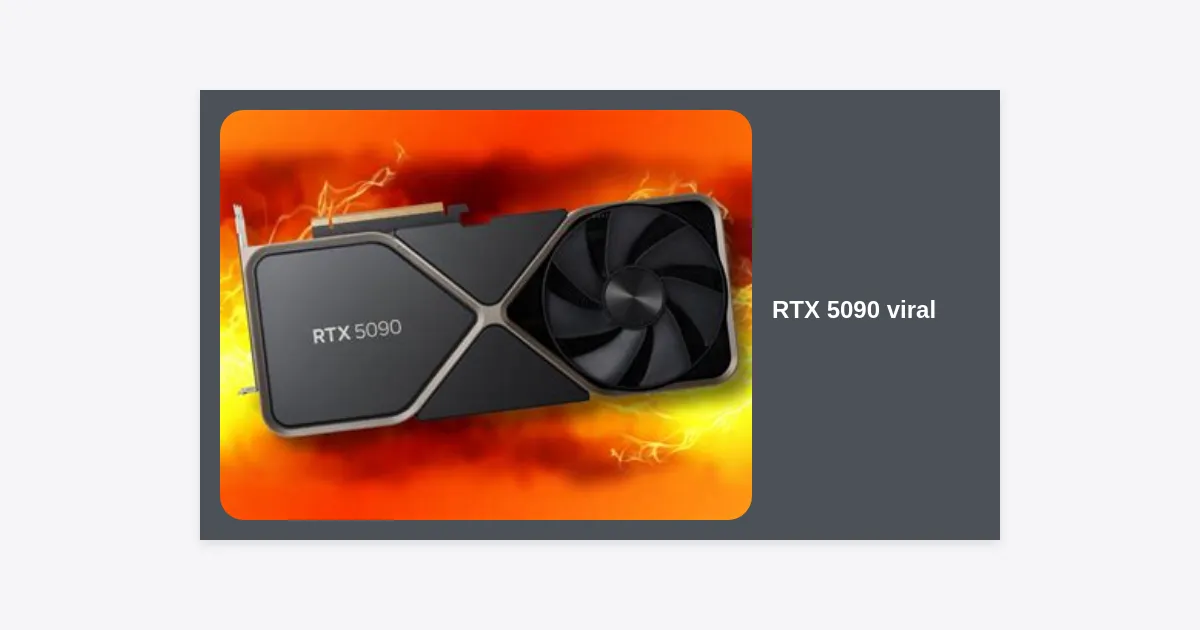
The RTX 5090 Viral Phenomenon: Why Everyone Is Talking
It’s not every day that a piece of computer hardware stops the internet, but the RTX 5090 viral rumors have done exactly that. From leaked blueprints on closed forums to breathless speculation on social media, the tech community is currently obsessed with what NVIDIA is cooking up for its next flagship. The transition from the Ada Lovelace architecture to the new Blackwell platform represents more than just a seasonal update; it’s a massive leap forward in computational power.
PC enthusiasts and professionals alike are searching for any scrap of information regarding this GPU. Whether you are a hardcore gamer looking for the ultimate 4K (or 8K) experience or a creative professional working with generative AI, the RTX 5090 promises to be the centerpiece of the next decade of computing. In this comprehensive guide, we will analyze why these leaks have gone viral and what you can actually expect when the card finally hits the shelves.
The anticipation isn’t just about speed; it’s about the potential for new technologies like DLSS 4 and breakthroughs in ray tracing pathing. As we look at the leaked data, it’s clear that NVIDIA isn’t just competing with AMD anymore—they are competing with their own legendary RTX 4090, which remains the king of the current generation.
Specifications: The Heart of the Blackwell Beast
According to the latest RTX 5090 viral leaks, the specifications for the GB202 die (the silicon powering the 5090) are nothing short of monstrous. Rumors suggest a massive increase in CUDA core counts, potentially reaching as high as 21,760 cores. This is a significant jump from the 16,384 cores found in the RTX 4090.
Architecture plays a pivotal role here. The Blackwell architecture is reportedly designed with a focus on high-efficiency data movement and specialized units for AI acceleration. This isn’t just a bigger chip; it’s a smarter one. If these leaked specs hold true, we are looking at a raw compute performance increase of roughly 50-70% over the previous generation.
Beyond the core count, the base and boost clock speeds are expected to push the boundaries of air-cooled silicon. Some insiders suggest we could see boost clocks exceeding 2.9 GHz out of the box, with aftermarket cards easily hitting the 3.0 GHz milestone. This frequency, combined with the wider memory bus, creates a throughput monster that will redefine what we consider “standard” performance.
Projected Performance: Beyond the RTX 4090
When discussing RTX 5090 viral news, the first question everyone asks is: “How much faster is it?” Early synthetic benchmark leaks suggest that the RTX 5090 could be up to 1.7x faster than the RTX 4090 in specific ray-tracing workloads. This is a staggering claim, given that the 4090 is already overkill for most 4K gaming scenarios.
“The RTX 5090 isn’t just a generational step; it’s a structural shift in how we process light and AI in real-time.”
— Leading Hardware Analyst
In real-world gaming, this could mean playing titles like Cyberpunk 2077 or Alan Wake 2 at full Path Tracing settings in 4K resolution at over 120 FPS without needing heavy frame generation. For enthusiasts with high-refresh-rate 4K monitors, this card will finally match the capabilities of their panels.
Furthermore, professional benchmarks in Blender, Octane, and DaVinci Resolve are expected to show even greater gains. The sheer VRAM capacity and memory bandwidth mean that rendering times for high-complexity 3D scenes could be cut in half, making the RTX 5090 a primary choice for high-end workstations.
The Power Crisis: Power Connectors and TDP
With great power comes great… electricity bills. One reason the RTX 5090 viral discourse has been so heated is the rumored power consumption. Current speculation suggests a Total Distribution Power (TDP) of 600W or even slightly higher for some Extreme Edition models.
This has raised concerns about the continuation of the 12VHPWR connector (or its updated 12V-2×6 version). Ensuring that these connectors can handle such a massive load without the melting issues seen in the early days of the RTX 4090 is a top priority for NVIDIA and board partners like ASUS, MSI, and EVGA (though notably, EVGA has left the market).
- Cooling Requirements: Expect triple-slot or even quadruple-slot coolers to be the norm.
- PSU Minimums: You will likely need a high-quality 1000W or 1200W ATX 3.1 power supply.
- Internal Heat: Case airflow will be more critical than ever to prevent the GPU from throttling.
The GDDR7 Revolution: Bandwidth for the Future
Perhaps the most significant technical advancement in the RTX 5090 viral specification list is the transition to GDDR7 memory. This new memory standard offers significantly higher bandwidth and better energy efficiency per bit compared to GDDR6X.
The RTX 5090 is rumored to feature a 512-bit memory bus, which, when paired with GDDR7 at 28Gbps or higher, would result in memory bandwidth exceeding 1.5 TB/s. This is an enormous leap that eliminates bottlenecks in high-resolution gaming and massive AI model training.
For gamers, this means smoother frame times and better 1% lows. For AI developers, it means the ability to load larger datasets and models directly onto the GPU memory without constant swapping to slower system RAM, dramatically accelerating training and inference times.
Gaming vs. AI: The Dual-Purpose Powerhouse
NVIDIA is no longer just a gaming company; they are an AI company. The 50-series Blackwell architecture is expected to inherit several features from NVIDIA’s H100 and B200 enterprise chips. This makes the RTX 5090 viral specs particularly interesting for the “prosumer” market.
We expect to see specialized Tensor Core updates that support new numeric formats, making it more efficient for running Local LLMs (Large Language Models) like Llama 3 or Stable Diffusion. As more software incorporates AI features, having this kind of local horsepower becomes a productivity necessity rather than a luxury.
On the gaming front, DLSS 4 (Deep Learning Super Sampling) is rumored to be in development. If history repeats itself, DLSS 4 might be exclusive to the RTX 50-series, utilizing the new hardware to provide even more realistic frame interpolation and image reconstruction with virtually no latency.
How to Prepare Your Build for the RTX 5090
If you are planning to join the 5090 club, you can’t just drop this card into a budget build. Based on the RTX 5090 viral data points, you should start auditing your PC now. Here is a practical checklist to ensure your system is “5090-ready.”
- Check your Case Dimensions: Ensure your chassis can hold a card that is likely 340mm+ in length and 150mm+ in width.
- Upgrade to ATX 3.1: If you are still on an older PSU, consider upgrading to an ATX 3.1 unit that natively supports the new power standards to avoid using adapters.
- CPU Bottlenecking: Pairing a 5090 with an old CPU is a waste. You should aim for at least a Ryzen 7 7800X3D or an Intel Core i9-14900K (or their upcoming successors).
- Monitor Check: Unless you are gaming at 4K 144Hz or using it for professional work, the 5090 will be severely underutilized.
To help you track your component compatibility, we have prepared a spec sheet comparison PDF for you to download and fill out.
Download RTX 5090 Build Checklist PDF
Release Date and Pricing Predictions
The million-dollar question—well, the two-thousand-dollar question—is when we can buy it and for how much. According to the RTX 5090 viral leak cycle, NVIDIA is likely targeting a late 2024 announcement with a retail launch in Q1 2025.
Regarding price, with the RTX 4090 sitting at an MSRP of $1,599 (but often selling for much more), the RTX 5090 is expected to see a price hike. Estimates range from $1,799 to a eye-watering $1,999. While this is expensive, the lack of competition at the ultra-high end from AMD (who is rumored to be focusing on the mid-range for RDNA 4) gives NVIDIA the leverage to maintain high margins.
| Feature | RTX 4090 | RTX 5090 (Rumored) |
|---|---|---|
| Architecture | Ada Lovelace | Blackwell |
| Memory | 24GB GDDR6X | 28GB-32GB GDDR7 |
| Memory Bus | 384-bit | 512-bit |
| TDP | 450W | 600W |
Final Verdict: Is the Hype Justified?
The RTX 5090 viral trend isn’t just noise; it’s a reflection of the massive excitement for what is likely the biggest architectural jump since the introduction of Ray Tracing. While the price and power requirements are daunting, the performance metrics suggested by recent leaks indicate that NVIDIA is ready to set a new, untouchable ceiling for consumer hardware.
Key Takeaways:
- Expect a 50-70% performance jump over the RTX 4090.
- GDDR7 memory will be the star of the show, providing unparalleled bandwidth.
- Prepare for high power consumption (600W) and a premium price tag ($1,799+).
- The card will be as much an AI workstation tool as it is a gaming GPU.
If you have the budget and the power supply to handle it, the RTX 5090 looks set to be the definitive GPU of the mid-2020s. Stay tuned for official announcements, likely at upcoming major tech showcases like CES.