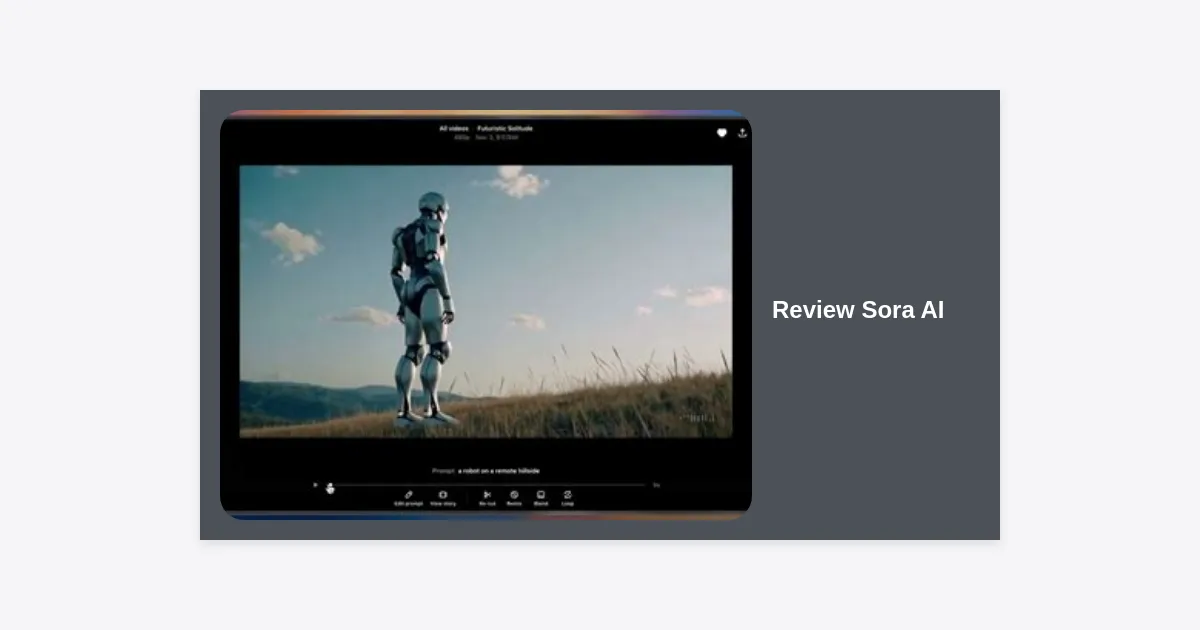
Introduction to Sora AI
The landscape of artificial intelligence is moving at a breakneck pace, and OpenAI has once again taken center stage. If you have been following the latest developments in generative media, you have likely heard the name “Sora.” In this comprehensive Review Sora AI, we will explore whether this text-to-video model lives up to the astronomical expectations set by its initial demos.
Imagine being able to type a single sentence and receiving a high-definition, cinematically lit, one-minute video in return. This isn’t just a dream anymore—it is the reality Sora promises to deliver. For content creators, marketers, and filmmakers, the implications are profound. This article serves as your definitive guide to understanding Sora’s capabilities, its technical underpinnings, and how it stacks up against other tools in the market.
What is Sora AI? A Deep Dive
Sora is a diffusion model developed by OpenAI that can generate videos up to a minute long while maintaining high visual quality and adherence to the user’s prompt. Unlike previous iterations of video AI that produced short, jittery clips, Sora aims for consistency and world logic. In any Review Sora AI, it is essential to note that Sora doesn’t just “stitch images together”; it understands (to a degree) the physics of the scene being rendered.
Originally announced in early 2024, Sora entered a phase of “red teaming” where safety experts and visual artists tested its boundaries. It represents a significant leap from GPT-4’s text capabilities and DALL-E’s image generation into the much more complex four-dimensional world of video (spatial dimensions plus time).
Key Features of Sora
When we look at what sets this tool apart, several features stand out as revolutionary. Here are the primary highlights of the Sora ecosystem:
- Long Duration: While most AI video generators are capped at 4 to 10 seconds, Sora can generate up to 60 seconds of continuous video.
- Complex Scene Generation: Sora can populate scenes with multiple characters, specific types of motion, and accurate details of the subject and background.
- Consistency: One of the biggest challenges in AI video is “morphing.” Sora maintains character and object persistence even when they temporarily move out of the frame.
- Multiple Camera Angles: The model can simulate complex camera movements like pans, tilts, and dollies, making the output look like it was shot by a professional cinematographer.
- Video-to-Video Editing: Beyond just text-to-video, Sora can take an existing video and transform its style or environment while keeping the core action intact.
The Technology Behind the Magic
To provide a technical Review Sora AI, we must look at how OpenAI bridged the gap between text and video. Sora is a diffusion transformer. It combines the strengths of diffusion models (like those used in Midjourney) with the transformer architecture (the “T” in GPT).
“Sora treats video like a collection of data ‘patches,’ similar to tokens in GPT. By breaking down videos into these small units, the model can learn the relationships between space and time more effectively.”
This “patch” approach allow the model to be trained on a vast array of visual data, ranging from different aspect ratios to different resolutions. By predicting what the next patch in a sequence should look like, Sora builds a coherent world. Statistics suggest that this architecture reduces the computational overhead compared to traditional pixel-by-pixel rendering, though it still requires massive GPU power.
Practical Use Cases for Creators
This Review Sora AI wouldn’t be complete without looking at how you can actually use it. The applications are limited only by your imagination, but here are the most promising fields:
1. Social Media and Marketing
Creating high-quality B-roll for YouTube or TikTok can be expensive and time-consuming. Sora allows marketers to generate custom background footage that perfectly matches their script without needing a camera crew or an expensive stock footage subscription.
2. Prototyping and Storyboarding
Filmmakers can use Sora to “pre-viz” (pre-visualize) scenes. Instead of rough sketches, directors can generate moving storyboards to show investors or crew members exactly what the pacing and lighting of a scene should look like.
3. Educational Content
Imagine a history teacher being able to generate a realistic simulation of a historical event or a science teacher showing a visual representation of a complex chemical reaction. Sora makes abstract concepts tangible.
Sora vs. The Competition (Runway, Pika, Luma)
The AI video space is crowded. In this Review Sora AI, we must see how it sits next to its rivals. Below is a comparison table highlighting the key differences:
| Feature | OpenAI Sora | Runway Gen-3 | Luma Dream Machine | Pika 1.5 |
|---|---|---|---|---|
| Max Duration | 60 Seconds | 10-20 Seconds | 5-10 Seconds | 4-10 Seconds |
| Visual Fidelity | Ultra-High | Very High | High | Stylized / High |
| Physics Logic | Strong | Moderate | Moderate | Moderate |
| Public Access | Limited / Red Team | Full Access | Full Access | Full Access |
While Sora currently leads in duration and consistency, tools like Runway and Luma have the advantage of being publicly available and integrated into existing creative workflows. Sora’s “moat” is its ability to handle complex physical interactions, such as a person eating a cookie and leaving a bite mark—a task that still trips up many other models.
Current Limitations and Hurdles
No Review Sora AI is honest without mentioning its flaws. Despite its power, Sora is not perfect. OpenAI itself has admitted that the model may struggle with simulating the physics of a complex scene accurately.
- Cause and Effect: Sora might show someone taking a bite out of a cookie, but the cookie might not have a bite mark afterward.
- Spatial Confusion: Characters might move in ways that defy gravity, or objects might spontaneously appear or disappear.
- Left vs. Right: Like many AI models, Sora can occasionally get confused about left and right or follow specific camera movement instructions inaccurately.
- Computation Time: Generating a minute of high-quality video is computationally expensive, leading to longer wait times compared to image generation.
Safety, Ethics, and Red Teaming
OpenAI is taking a cautious approach with Sora. They are working with red teamers—experts in fields like misinformation, hateful content, and bias—to test the model. One of the biggest concerns with a tool this powerful is the creation of deepfakes and misinformation.
To combat this, Sora includes:
- C2PA Metadata: This is a standard that helps identify that a video was generated by AI.
- Detection Classifiers: OpenAI is developing tools to help identify videos made by Sora.
- Safety Filters: The model is designed to reject prompts that request extreme violence, sexual content, or the likeness of real-world celebrities.
The Final Verdict: Review Sora AI
In conclusion, Sora AI is a monumental achievement in the field of generative artificial intelligence. It bridges the gap between text and cinematic video in a way that feels like magic. While it is still in a controlled release phase, the potential for disruption in the creative industry is undeniable.
Key Takeaways:
- Sora sets the gold standard for video duration (60 seconds).
- It exhibits a sophisticated understanding of cinematic language and world physics.
- Current limitations in cause-and-effect physics mean it’s not yet a replacement for traditional filming in all scenarios.
- Its eventual public release will require robust safety measures to prevent misuse.
If you are a creator, now is the time to start thinking about how AI video integrates into your workflow. Whether you choose to Review Sora AI for your personal projects or wait for its public release, the future of video is undoubtedly here.
As Sora becomes more widely available, we will update this review with specific pricing plans and more hands-on testing data. Stay tuned!